
URLs are often treated as a technical detail to deal with later. In reality this is one of the cheapest SEO wins available, no expensive tools and no big team required. The data is also clear, short and clean URLs correlate with higher rankings. This article breaks down what a URL is, its structure with examples, and how to write URLs that both Google and humans love.
Key takeaways
A URL is the complete address of a page or file on the internet, covering the protocol, domain, and path to a specific page.
Around 96 percent of Chrome page loads now happen over HTTPS. Sites still on HTTP have effectively lost the trust of both visitors and search engines.
Backlinko's study of 11.8 million search results found that URLs at position 1 average 9.2 fewer characters than those at position 10.
A good URL is short, uses hyphens, and contains the page's primary keyword.
What Is a URL? The Full Definition
A URL, or Uniform Resource Locator, is the complete address pointing to one specific page or file on the internet. If the domain is the house address, the URL is the full address down to the room number. For example, soedja.com is a domain, while soedja.com/blog/what-is-a-url is the URL of one specific article on this website.
URL Structure and Examples
Every URL is built from components with distinct jobs. Once you understand the anatomy, decisions about slugs, subdomains, and parameters become much easier. Take https://blog.soedja.com/blog/what-is-a-url?utm_source=newsletter#structure as an example
Component | Part | Function |
|---|---|---|
Protocol | https:// | Data transfer rules, the secure version of http |
Subdomain | blog. | A separate section of the main site |
Domain | The site name and its extension | |
Path | /blog/what-is-a-url | The specific page location, its last part is the slug |
Parameter | ?utm_source=newsletter | Extra data for tracking or filtering |
Fragment | #structure | A jump to a specific section of the page |
For SEO purposes, the two components you touch most often are the path and the slug. That is where the page's primary keyword lives, and where most mistakes happen.
URL Data You Should Know
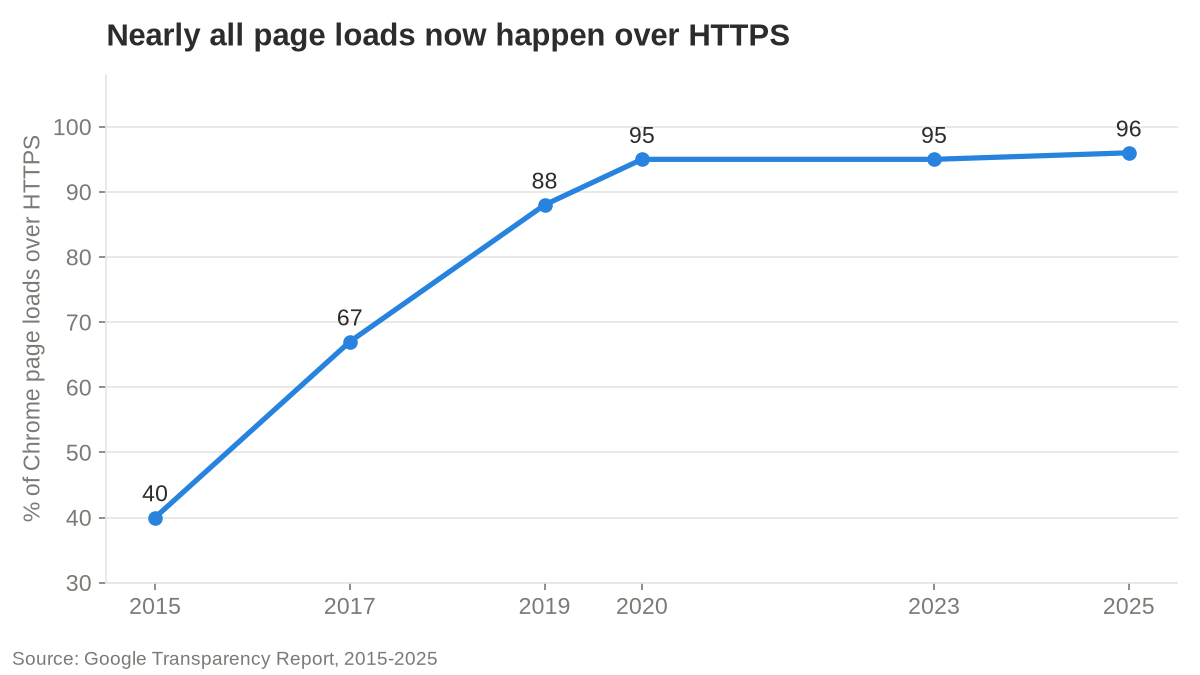
Chart of HTTPS adoption in Chrome 2015 to 2025
The Google Transparency Report shows HTTPS adoption climbing from around 40 percent in 2015 to about 96 percent of Chrome page loads in 2025. Starting in 2026, Chrome even makes secure connections the default. If your site is still on HTTP, browsers flag it as not secure and visitors leave before the page opens.
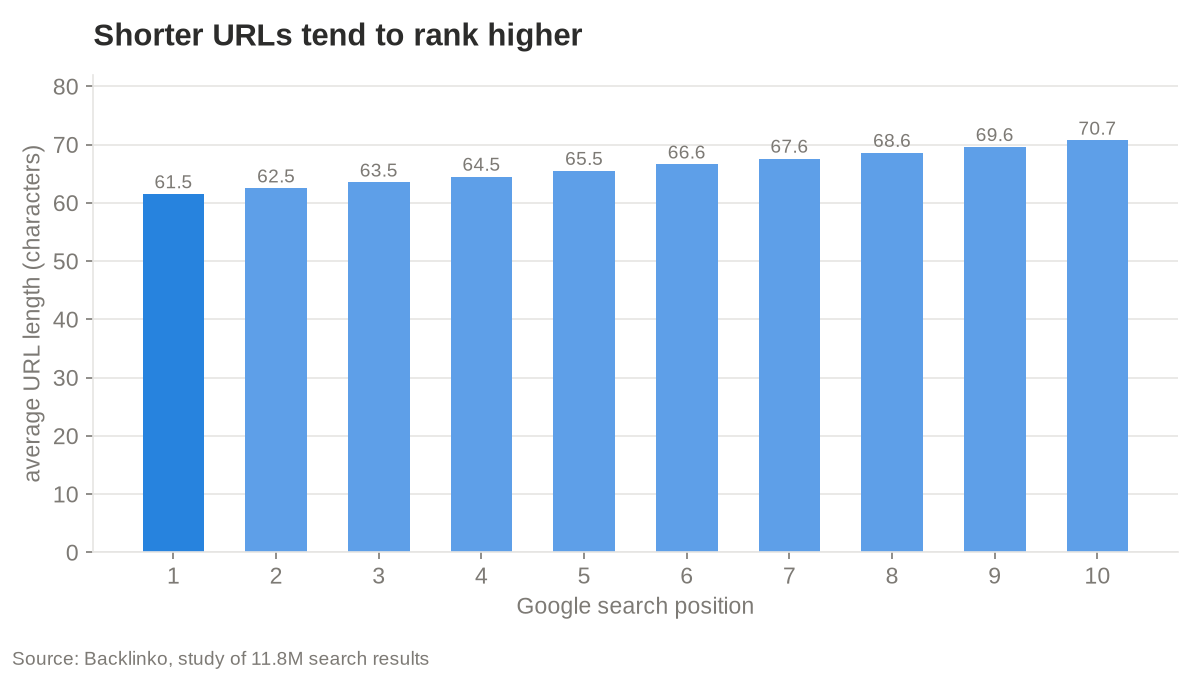
Chart of URL length vs Google ranking position
Backlinko's study of 11.8 million search results found a clear correlation, URLs at position 1 average 61.5 characters while position 10 averages 70.7. Short URLs are easier for search engines to understand and more attractive to click. The average first-page URL sits at 66 characters.
How to Write SEO-Friendly URLs
The rules are simple and cost almost nothing, they just take discipline from the very first page you publish.
Use HTTPS, no exceptions.
Keep slugs short and keyword-focused, for example /what-is-a-url, not /what-is-a-url-definition-functions-and-complete-examples.
Separate words with hyphens, not underscores or spaces.
Use all lowercase to avoid duplicate capitalized versions.
Avoid excessive parameters on URLs you want to rank, save parameters for campaign tracking.
If you must change an old URL, always set a 301 redirect to the new one.
A keyword-rich slug also lifts click through rate in search results. We cover that in depth in what is CTR.
FAQ
What is the difference between a URL, a domain, and a link?
The domain is the site name. The URL is the full address of one page. A link is a clickable element that points to a URL.
What is a slug?
The slug is the final part of a URL that identifies one page, for example what-is-a-url in soedja.com/blog/what-is-a-url.
Is changing URLs bad for SEO?
It is risky without redirects. Always set a 301 redirect from the old URL to the new one so page authority is preserved. Learn the fundamentals in what is SEO.
What does a good URL look like?
The ideal format is https, then the domain, then a short keyword slug. For example soedja.com/blog/what-is-seo. Short, descriptive, and readable before anyone clicks.
Do capital letters in URLs matter?
They do. Servers can treat /Blog and /blog as two different pages, which creates duplicate content. Use all lowercase from the start.
Conclusion
A URL is a small detail with real impact. The data shows short URLs correlate with higher rankings and HTTPS is now an absolute standard. Get your URL structure right from the start so you never need a painful migration later. If you want traffic and conversions to grow faster, check out Soedja's performance ads service and start keyword research with Soedja's free tools.
Editorial Team