




SEO is the set of practices that gets a website to the top of Google's organic search results without paying for ads. It works by understanding what people search for, then building the content and site structure that best deserves to answer it. The result is traffic that keeps coming without a cost per click.
Key takeaways
SEO (search engine optimization) is the work of ranking higher in organic search results, not in the ad slots.
Position is everything. The #1 organic result earns an average CTR of 39.8%, while position 10 gets just 1.6%.
In Indonesia, Google holds 93.65% of the search engine market, so in practice SEO means optimizing for Google.
SEO breaks down into three areas of work, namely on-page, off-page, and technical. All three have to run together.
AI Overviews are changing how people click. SEO strategy now needs to be paired with optimization for AI engines.
What is SEO
SEO stands for search engine optimization. In essence, search engines like Google list the pages they consider most relevant and credible for every query. SEO is the work of making your page one of the chosen ones.
Unlike search ads, you do not pay Google to appear. What you invest is the time and effort for keyword research, content that deserves to rank, and a technically clean website. Paid and organic approaches complement each other, and how to combine them is covered in our digital marketing strategy guide.
Why SEO matters
First, clicks on Google skew heavily toward the top. First Page Sage's 2026 meta-analysis shows the #1 organic position earns an average CTR of 39.8%, and the top three positions absorb 68.7% of all clicks. If your content sits on page two, you get practically nothing.
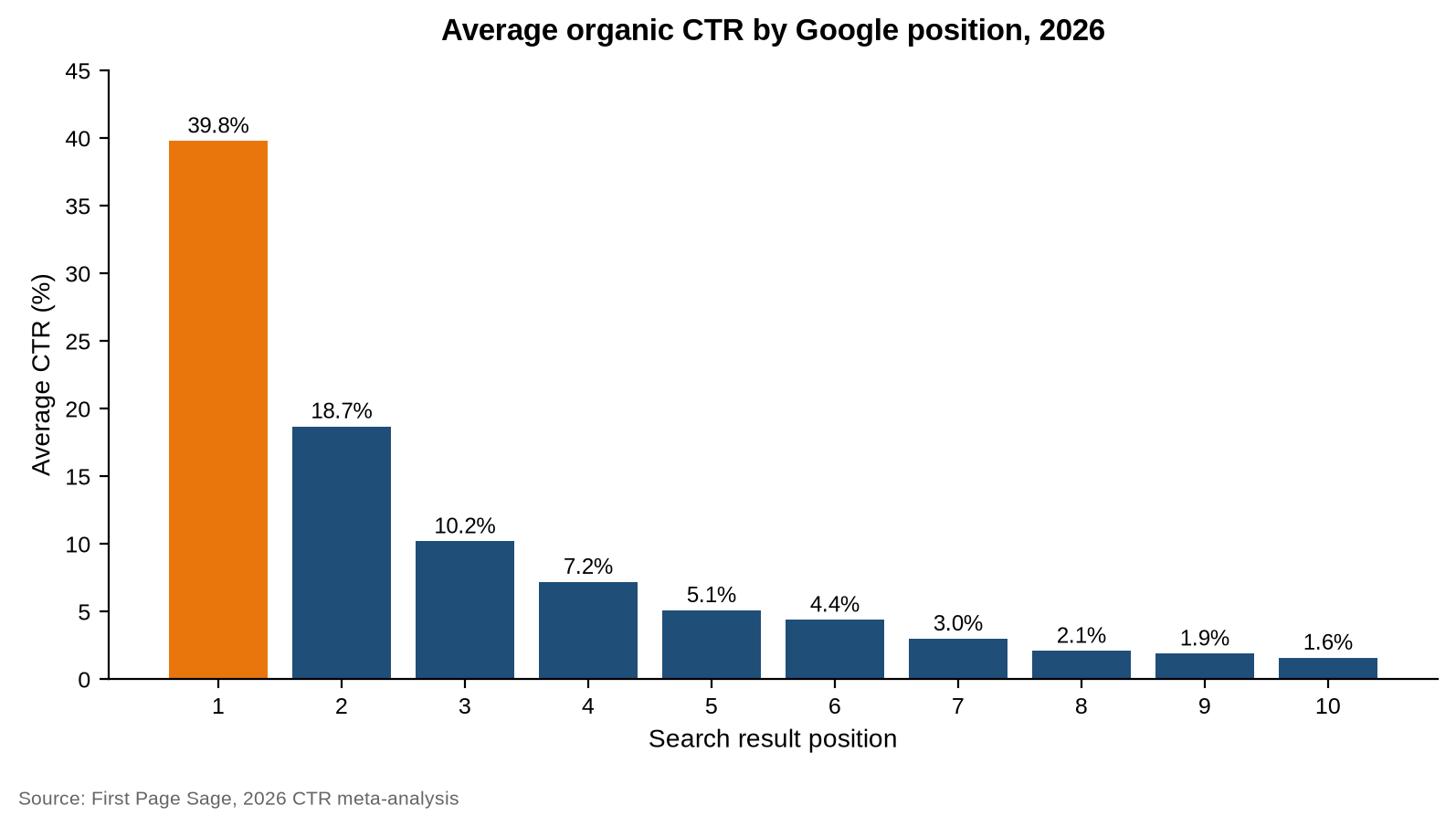
Average organic CTR by Google position, First Page Sage 2026 data
Second, the top organic result gets roughly 19 times more clicks than the top search ad. Organic traffic also does not stop when the budget runs out, unlike the paid channels covered in our performance marketing guide.
Third, specifically for the Indonesian market, almost all searches happen in one place. StatCounter data for June 2026 shows Google holds 93.65% of Indonesia's search engine market, and 97.26% on mobile devices.
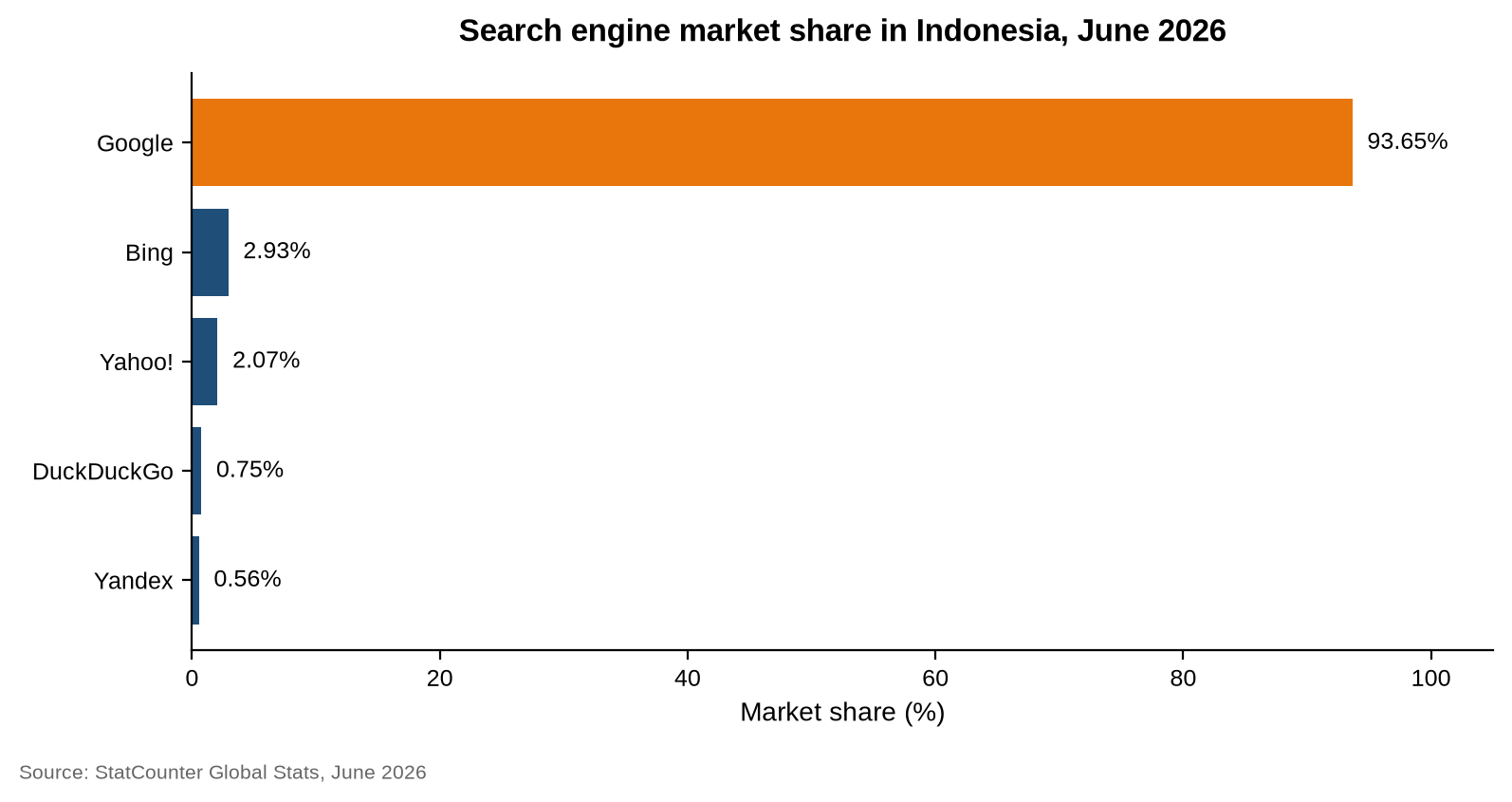
Search engine market share in Indonesia, StatCounter June 2026 data
How search engines work
Google works in three stages. First crawling, where Google's robots explore pages across the internet through links. Second indexing, where discovered pages are stored and understood. Third ranking, where Google orders the pages in its index based on hundreds of relevance and credibility signals whenever someone searches.
SEO work is essentially making sure those three stages run smoothly for your website. Pages can be found, can be understood, and deserve priority.
Search intent, understand the why behind the query
Before any optimization, you have to understand why someone types a particular keyword. Google ranks pages by how well the answer matches the intent of the search, not just keyword matching. There are four types of search intent to recognize.
Intent type | What the user wants | Example keywords | Content format that fits |
|---|---|---|---|
Informational | Answers or knowledge | what is seo, how google works | Guides, educational blog posts |
Navigational | A specific site or brand | semrush login, soedja tools | Brand pages, product pages |
Commercial | Comparison before buying | semrush vs ahrefs, best seo agency | Comparison articles, reviews |
Transactional | Making a purchase or taking action | seo service pricing, seo course signup | Landing pages, service pages |
The most common mistake is targeting transactional keywords with blog articles or the other way around. No matter how good the content is, if the format does not match the intent, Google will not push it up.
The three types of SEO work
Area | Focus | Example tasks |
|---|---|---|
On-page SEO | Page content and structure | Keyword research, article writing, headings, internal links, title tags and meta descriptions |
Off-page SEO | Reputation beyond your site | Backlinks from credible sites, brand mentions, digital PR |
Technical SEO | Technical site health | Page speed, mobile friendliness, URL structure, sitemaps, schema markup |
For most businesses the priority order starts with technical basics so the site can be crawled, then on-page because content is what actually gets ranked, then off-page to accelerate.
The on-page practices that matter most
One page, one primary keyword. Pages that chase many keywords at once usually lose to focused ones.
Title tags of roughly 60 characters with the keyword up front, since this is the text that most determines clicks.
A direct answer in the first paragraph, because both Google and AI engines pull their snippets from there.
H2 and H3 headings that answer related questions, so one page can win many query variations at once.
Internal links between articles on the same topic with descriptive anchor text, the pillar and cluster pattern this blog uses.
Alt text on images and descriptive file names.
Off-page SEO and how to build backlinks
Backlinks remain one of the strongest ranking signals, but quality beats quantity. One link from national media or a relevant industry site is worth far more than hundreds from junk directories. The safe ways to build them: publish original data or research worth citing, write guest posts on industry sites, build media relationships through digital PR, and create free tools or templates people want to link to. Avoid buying bulk backlinks. Google detects them very well and the penalty can wipe a site out of search results.
Technical SEO and Core Web Vitals
The technical priorities that cause the most problems: page speed with Largest Contentful Paint under 2.5 seconds, layout stability while loading, mobile friendliness since Google uses mobile-first indexing, HTTPS, an XML sitemap registered in Search Console, and schema markup so search engines understand your content type. For small sites on modern platforms like Webflow or WordPress with a light theme, most of this works by default. What matters is checking the Core Web Vitals report in Search Console regularly.
E-E-A-T, the credibility signals Google evaluates
Google assesses content quality through the E-E-A-T framework: experience, expertise, authoritativeness, and trustworthiness. In practice, show real experience through case studies, your own data, and screenshots. Display a clear author with credentials and a profile page. Write consistently on one topic so the site is seen as an authority in that field. Maintain trust through cited sources, accurate data, and a clear contact page. E-E-A-T is not a single ranking factor but the framework Google uses to judge quality, and it matters most for topics that touch money and health.
SEO vs SEM, what is the difference
Aspect | SEO (organic) | SEM (search ads) |
|---|---|---|
Cost | No cost per click, the investment is in content | Pay per click |
Speed of results | 3 to 6 months before it shows | Instant once ads are live |
Durability | Traffic persists after rankings rise | Stops when the budget stops |
User trust | The #1 organic result gets about 19x more clicks than the top ad | Labeled as ads, some users skip them |
They are not an either-or choice. The common pattern is SEM for fast results while SEO is built as the long-term foundation. The ad metrics themselves, such as CTR and CPC, are covered in our metrics cluster.
Local SEO for businesses with a physical presence
If your business serves a specific area, there is an extra SEO layer that often gets forgotten. Optimize your Google Business Profile with categories, opening hours, photos, and regularly answered reviews, because local results, the map pack, appear above regular organic results for searches like digital marketing agency near me. Consistent name, address, and phone number across the internet is another important signal. For most small businesses, local SEO delivers results faster than competing on national keywords.
SEO in the AI search era
Search behavior is changing fast. SparkToro research shows 68.01% of US Google searches in early 2026 ended without any click, up from 60.45% in 2024. The main driver is AI Overviews, AI answers that now appear on more than 20% of searches and cut organic CTR by nearly 60% when present.
That means winning rankings alone is no longer enough. Your content also has to become a source that AI engines like AI Overviews, ChatGPT, and Perplexity cite. How to optimize for that is covered in our AI search engine optimization article.
Where to start
Keyword research. Find the keywords your audience searches for with competition levels that are still reasonable.
Map your content with the pillar and cluster model. One main page for the big topic, supporting articles for its subtopics, all connected through internal links.
Write content that answers directly. The answer in the first paragraph, elaboration after, closing with an FAQ.
Clean up the technical basics. Page speed, mobile friendliness, sitemaps, and schema markup.
Measure through Google Search Console. Monitor impressions, clicks, and position per page, then fix pages with high impressions but low CTR.
If you are just starting to build your team's capability in this area, our digital marketing learning roadmap is a good starting point.
The SEO metrics to monitor
Metric | What it means | Where to see it |
|---|---|---|
Impressions | How often your page appears in search results | Google Search Console |
Clicks and CTR | How many actually click through | Google Search Console |
Average position | Average rank per keyword | Google Search Console |
Organic traffic | Visits from unpaid search | Google Analytics |
Organic conversions | Leads or transactions from organic traffic | Google Analytics, CRM |
The most useful analysis pattern: find pages with high impressions but low CTR, then rewrite their titles and meta descriptions. It is the fix with the smallest effort and the fastest impact.
The most common SEO mistakes
Keyword stuffing, repeating keywords unnaturally. Google has penalized this for years.
Writing for machines instead of humans. Content people do not finish reading loses rank.
Wrong intent, targeting commercial keywords with informational articles or the reverse.
Buying cheap bulk backlinks that risk penalties.
Ignoring old content. Updating articles that slipped in rank often beats writing new ones.
Impatience. Quitting in month two when SEO results only show from months three to six.
Tools to get started
Google Search Console for organic performance data, Google Analytics for visitor behavior, and keyword research tools like Ubersuggest or Semrush. For analyzing the paid side alongside it, you can use Soedja's free ad analysis tools.
FAQ
What is SEO in simple terms?
The effort to make your website appear at the top of Google's search results without paying for ads, by creating the content that best deserves to answer what people search for.
How long does SEO take to show results?
Generally 3 to 6 months for moderately competitive keywords. Highly competitive keywords can take longer. It is a long-term investment, not an instant tactic.
Is SEO still relevant with AI Overviews?
Yes, but the shape is shifting. The sources cited by AI Overviews are drawn from pages that already win organically, so SEO fundamentals remain the prerequisite.
What is the difference between SEO and SEM?
SEO pursues organic results with no cost per click, SEM pays to appear in ad slots. They are usually used together.
How much does SEO cost?
Done in-house, the cost is your team's time plus research tools. With an agency in Indonesia it generally starts at a few million rupiah per month, depending on scope. Always compare it against what the equivalent traffic would cost through ads.
What are long tail keywords and why do they matter?
Longer, more specific keywords with small volume but low competition and clear intent. For a new website, winning many long tail keywords is usually the fastest path before attacking big keywords.
Conclusion
SEO is the most durable way to earn traffic because the results do not vanish when spending stops. The keys are patience early on, discipline in keyword research, and consistently publishing content that answers directly. If you want faster parallel results while your SEO grows, talk to Soedja about your advertising needs.
Founders at Soedja