





CTR stands for click-through rate, the percentage of people who click your ad compared to the number of people who see it. The formula is clicks divided by impressions times 100 percent, so an ad shown 10,000 times and clicked 200 times has a CTR of 2 percent.
Quick summary
CTR is the ratio of clicks to impressions, a measure of how compelling your ad is to the audience that sees it
A healthy CTR differs wildly between platforms, 3 percent is normal on search while 0.5 percent is already good on display
CTR feeds quality score, and quality score decides how cheap or expensive your ads get
A high CTR with no conversions means the problem sits on the landing page, not in the ad
The biggest CTR gains usually come from message relevance, not from swapping images
What Is CTR?
Every ad that gets shown has two possible outcomes, ignored or clicked. CTR measures how often the second one happens. Because it is a ratio, CTR is the fastest way to judge whether your ad message resonates with the audience seeing it, regardless of budget size.
CTR is also used outside advertising. Email marketing counts CTR from clicked links, and organic search results have a CTR by ranking position. The principle is the same, what percentage of people who saw something then acted. This article focuses on digital ad CTR.
How to Calculate CTR with an Example
CTR = (clicks ÷ impressions) × 100%
For example, your search ad is shown 25,000 times in a week and earns 700 clicks. CTR = (700 ÷ 25,000) × 100% = 2.8%.
One thing that often gets missed, calculate CTR per level. An account level CTR that looks healthy can hide one ad group whose CTR has collapsed. Break the calculation down to campaign, ad group, and individual ad level so you can see which part is dragging the average down.
CTR Benchmarks by Platform and Format
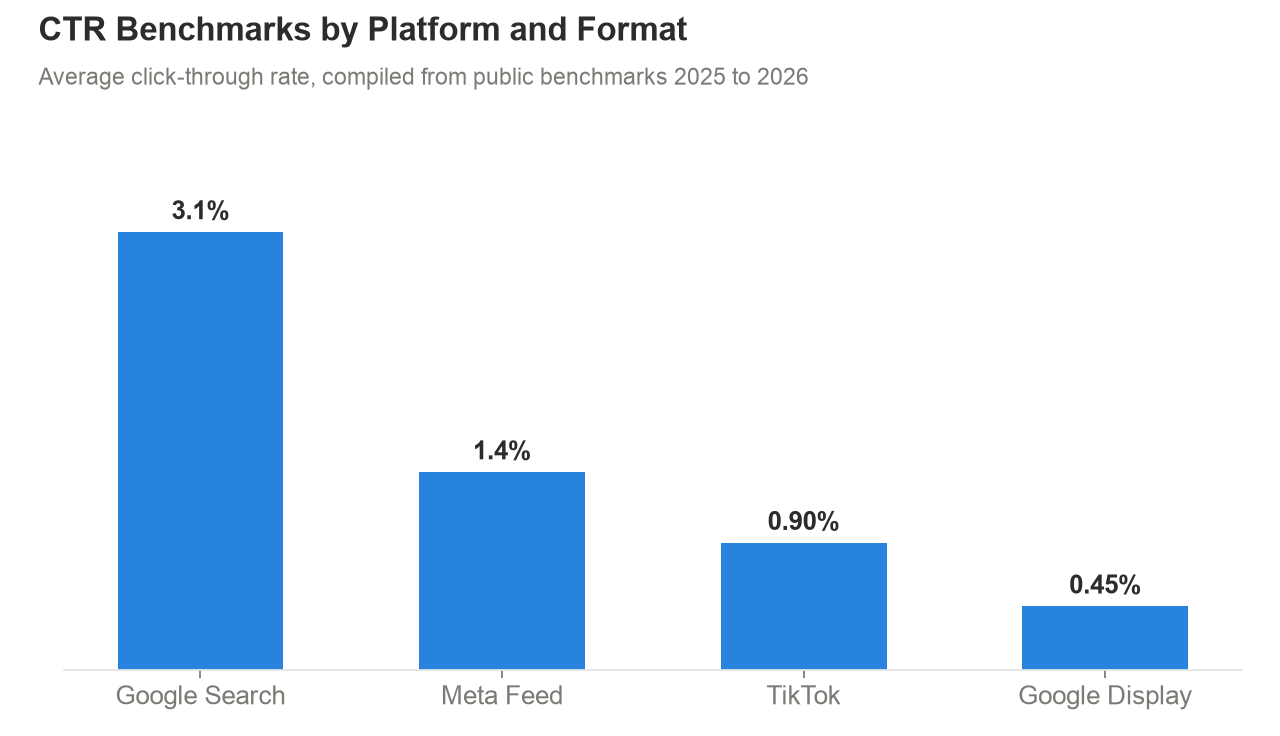
CTR benchmarks by platform and ad format, compiled from public benchmarks
Never compare CTR across formats. A 1 percent CTR on Google Search is poor, while the same number on Google Display is double the average. Search is always higher because the person is actively looking, while display and social interrupt people who are doing something else.
These benchmarks are a starting point, not a finish line. The best comparison remains your own campaign history in the same format.
Why CTR Matters for Quality Score and Ad Costs
CTR is not a cosmetic number. Google uses expected CTR as a component of quality score, and Meta uses estimated action rates when calculating total value. In practice, platforms charge less for ads that get clicked more, because those ads are considered relevant to their users.
The pattern is obvious once CTR and CPC are plotted together.
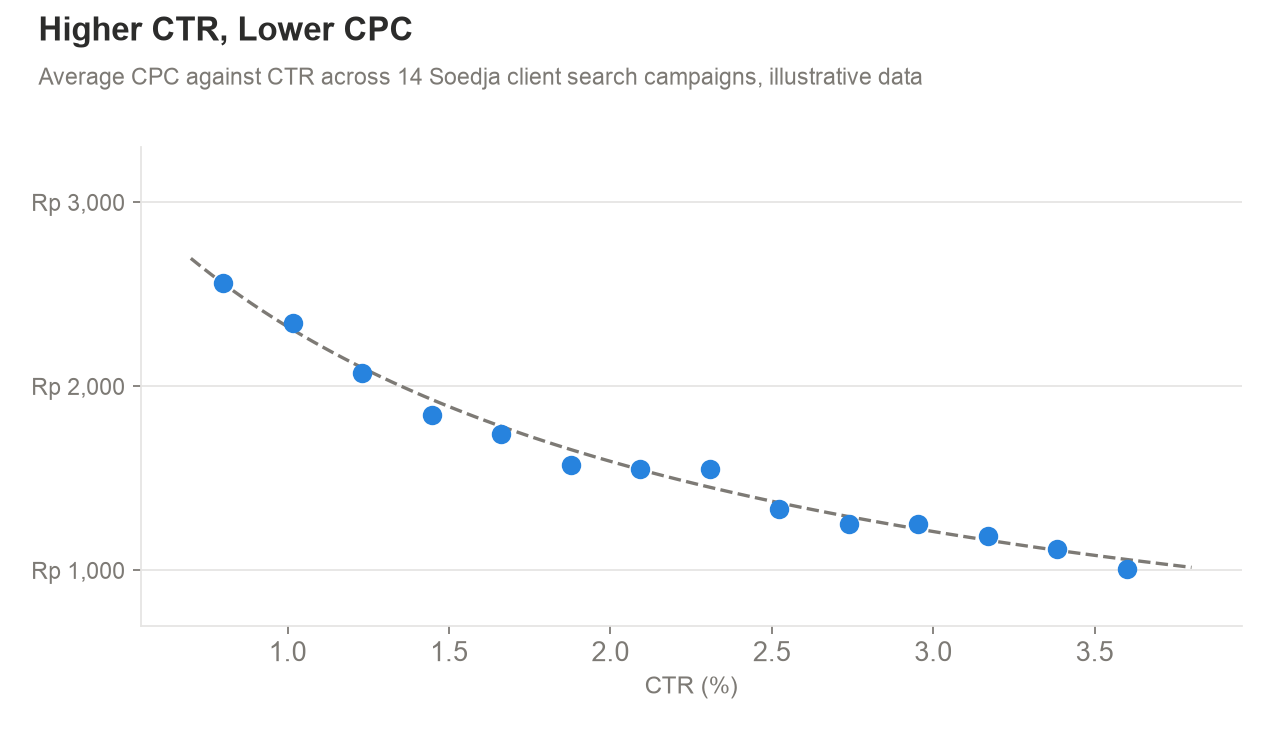
CTR against CPC correlation from Soedja client campaigns, illustrative data
Campaigns with a CTR below 1 percent pay two to three times more per click than campaigns whose CTR sits above 3 percent. Raising CTR is often the cheapest way to lower CPC without touching bids at all.
One important note, a high CTR is not the end goal. If clicks pile up but transactions never come, the problem has moved to the landing page or to the quality of the traffic. Always measure CTR together with conversions.
6 Ways to Fix a Low CTR
Match the ad message to search intent. Someone searching for welding service prices needs numbers, not slogans. A headline that answers exactly what was searched always beats a generic one
Use specific numbers and proof. Down 44 percent is more compelling than much more efficient. Specific feels credible, generic feels like an ad
Fix the first three seconds of the hook. On video and social, the scroll decision happens before second three. If the hook misses, the rest is never seen
Add negative keywords. A low CTR is often not because the ad is bad, but because it shows up for irrelevant searches. Cut the junk impressions and CTR rises on its own
Write copy that sells without feeling salesy. A soft selling approach usually wins with cold audiences because it does not trigger people's defenses against ads
Test one variable at a time. Changing the headline and the image at once means you never learn which one worked. Disciplined one-at-a-time testing is slower but the results are reusable
Frequently Asked Questions
What does CTR mean?
CTR means click-through rate, the percentage of ad views that end in a click. A 2 percent CTR means that out of 100 times the ad was shown, 2 people clicked it.
What is a good CTR?
It depends on the format. On Google Search, 3 percent and above is healthy. On Meta feed around 1 to 2 percent, and on Google Display 0.5 percent is already above average. Compare within the same format, never across formats.
Why is my ad CTR low?
The three most common causes, the ad shows to irrelevant audiences or searches, the message does not answer what people are looking for, or the creative has worn out from running too long. Check targeting first, then the message, then the creative.
Conclusion
CTR is a measure of attention. It tells you whether your ad is relevant enough to make people stop and click, and through quality score it helps decide how much you pay per click. Raise CTR through message relevance, then make sure those clicks turn into results by measuring conversions and watching CPC on the cost side.
For the bigger framework, read our complete performance marketing guide. To check whether your campaign CTR is healthy, use our free ads analysis tools. And if you need a team that fixes ads all the way to business numbers, Soedja Performance Ads can help, the first consultation is free.
Editorial Team