




Picture a potential customer searching for your product at 11 pm. The store is closed, the admin is asleep, but the search still happens. The only thing that can answer them in that moment is your website. The problem is that many businesses build a website just to have one, then wonder why nobody ever visits. This article covers what a website is, what it does for a business, the main types, and how to build one with the right SEO foundation from day one.
Key takeaways
A website is a collection of interconnected web pages under one domain name, accessible over the internet.
The world has about 1.49 billion websites, but only around 217.7 million are actually active. Your real competition is far smaller than the headline number.
Internet penetration in Indonesia has reached 81.72 percent, or 235.2 million people, according to the 2026 APJII survey.
Every website needs three core components, a domain, hosting, and content. Without an SEO strategy, all three are just a digital brochure nobody visits.
What Is a Website? The Full Definition
A website is a collection of web pages containing text, images, videos, and interactive elements, connected under one domain address and stored on a hosting server so browsers can access it. When you type soedja.com, your browser fetches files from the server and renders them as the page you see.
For a business, a website is a digital asset you fully control. Unlike social media accounts that live under a platform's algorithm, a website is your own property. All the organic traffic from your SEO strategy flows into this asset.
Here is a simple analogy. Social media is a rented stall in someone else's market, the rules can change any time and your stall can be moved without notice. A website is a building you own. You decide the layout, the content, and the experience of every visitor who walks in.
What a Website Does for Your Business
A website is not a decoration. Done right, one website performs several jobs at once.
Builds credibility. Buyers almost always check a website before trusting a brand. If they cannot find one, they move on to a competitor they can find.
Drives organic traffic. Every article that answers a real search works 24 hours a day, attracting visitors without a cost per click.
Captures and converts leads. Forms, catalogs, and offer pages turn anonymous visitors into prospects you can follow up with.
Becomes your data hub. Analytics tells you who your audience is, where they come from, and which content actually works.
How Many Websites Are There
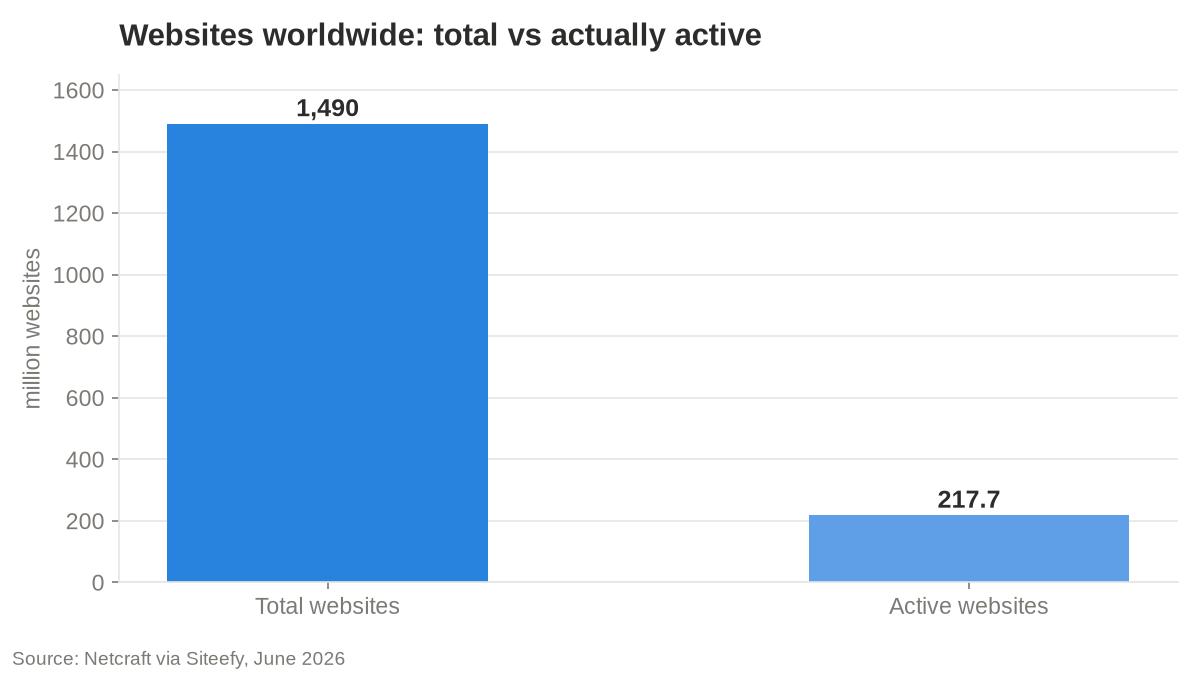
Chart of total vs active websites worldwide
Netcraft data compiled by Siteefy as of June 2026 counts about 1.49 billion websites worldwide, yet only around 217.7 million are active. Roughly 85 percent of the rest are parked domains or abandoned sites. The practical takeaway, your real competition is not billions of sites but the active sites in your niche that take content seriously.
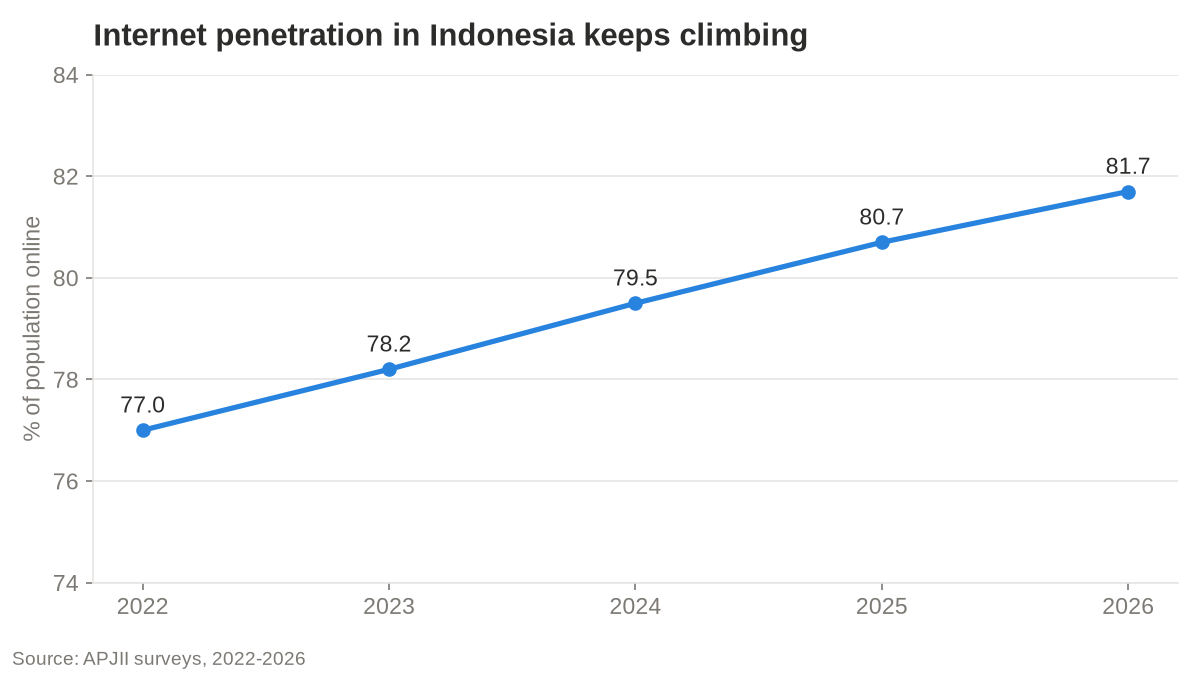
Chart of Indonesia internet penetration 2022 to 2026
In Indonesia, the 2026 APJII survey puts internet penetration at 81.72 percent, or 235.2 million out of 287.9 million people, climbing steadily every year since 2022. The market is online. The only question is whether they can find you.
Types of Websites and Examples
The type of website determines the page structure, the content style, and how you measure success. Pick the wrong type up front and the whole strategy goes wrong with it. These are the five types businesses use most.
Type | Main goal | Examples |
|---|---|---|
Company profile | Build business credibility | Agency, contractor, clinic sites |
E-commerce | Sell products directly | Online stores, marketplaces |
Blog and media | Attract organic traffic through content | News portals, educational blogs |
Landing page | Convert for one specific campaign | Promo pages, signup pages |
Web app | Deliver interactive services | SaaS dashboards, internet banking |
Most businesses need a combination. A company profile for credibility, a blog for organic traffic, and landing pages for performance marketing campaigns.
Core Elements of a Website
Domain, the unique address visitors type. Read more in our what is a domain guide.
Hosting, the server where your website files live.
CMS or framework, the system for managing content, such as WordPress or Next.js.
Design and UX, the look and ease of navigation.
Content, the text, images, and videos that answer visitor needs.
SEO, optimization so pages appear in search results. Start with what is SEO.
How to Build a Business Website
Define the primary goal. Credibility, sales, or organic traffic. This goal drives every decision that follows, from page structure to platform choice.
Do keyword research before designing the structure. Most businesses build pages first and think about SEO later. Reverse the order, find out what your audience searches for, then build pages that answer it.
Choose a short, memorable domain name. The full guide is in what is a domain.
Pick hosting with good speed and uptime. Page speed affects rankings and conversions alike, visitors will not wait for a slow page.
Build the core pages first. Home, services, about, contact, and blog. Everything else comes after the foundation is standing.
Install analytics from day one. Without data, every next decision is a guess.
The most common mistake happens at step two. A website built without keyword research usually looks polished but sits empty, because none of its pages answer what people actually search for.
FAQ
What is the difference between a website and a blog?
A blog is one type of website that publishes articles on a regular basis. Every blog is a website, but not every website is a blog.
What do I need to build a website?
At minimum three things, a domain name, hosting, and content. For business results, add an SEO strategy and analytics.
How much does a website cost?
A .com domain runs about 10 to 15 USD per year and basic hosting starts around 20 USD per year. The biggest costs are usually design and content, not infrastructure.
Can I build a website for free?
Yes, through platforms like WordPress.com or Google Sites. But you do not get your own domain and control is limited. For a business, your own domain and hosting are a small investment with a large credibility difference.
How long does it take to build a website?
A simple landing page can be done in days. A complete business website with a proper SEO structure usually takes two to six weeks, depending on the number of pages and how ready your content is.
Conclusion
A website is the foundation of your entire digital presence. The data is clear, 235.2 million Indonesians are already online while most websites in the world sit inactive. The opportunity is in execution, not technology. If you want a website that drives traffic and conversions, the Soedja team can help through our performance ads service. Also check out Soedja's free tools to start your keyword research today.
Editorial Team