




A domain name is a five-minute decision with effects that last for years. Choose badly and you are stuck with an address that is hard to spell, hard to remember, and hard to build authority on. Meanwhile the good names keep disappearing, hundreds of thousands of new domains are registered every day. This article covers what a domain is, how it works, the types with examples, and how to pick the right name before someone else takes it.
Key takeaways
A domain is the unique address used to access a website, replacing the hard-to-remember numbers of an IP address.
Global domain registrations hit 401.6 million in Q2 2026, up 8.1 percent year over year according to Verisign.
.com still dominates with 166.6 million registrations, followed by ccTLDs at 148.6 million.
A good domain name is short, easy to spell, and consistent with your brand. It is a long-term asset, so choose deliberately.
What Is a Domain? Definition and How It Works
A domain is the unique name that serves as the address of a website on the internet, such as soedja.com. Behind the scenes, computers communicate through numeric IP addresses. The DNS system translates domain names into those IP addresses, so you only need to remember the name, not the numbers.
A simple analogy, the IP address is a GPS coordinate and the domain is the street name. Nobody memorizes coordinates to reach a destination, everyone remembers the street. The easier the name is to remember, the more often people come back without searching again.
A domain name has three parts. Take blog.soedja.com, blog is the subdomain, soedja is the domain name, and .com is the extension, also called the TLD. Your domain is also part of every URL on your site.
The Latest Domain Industry Data
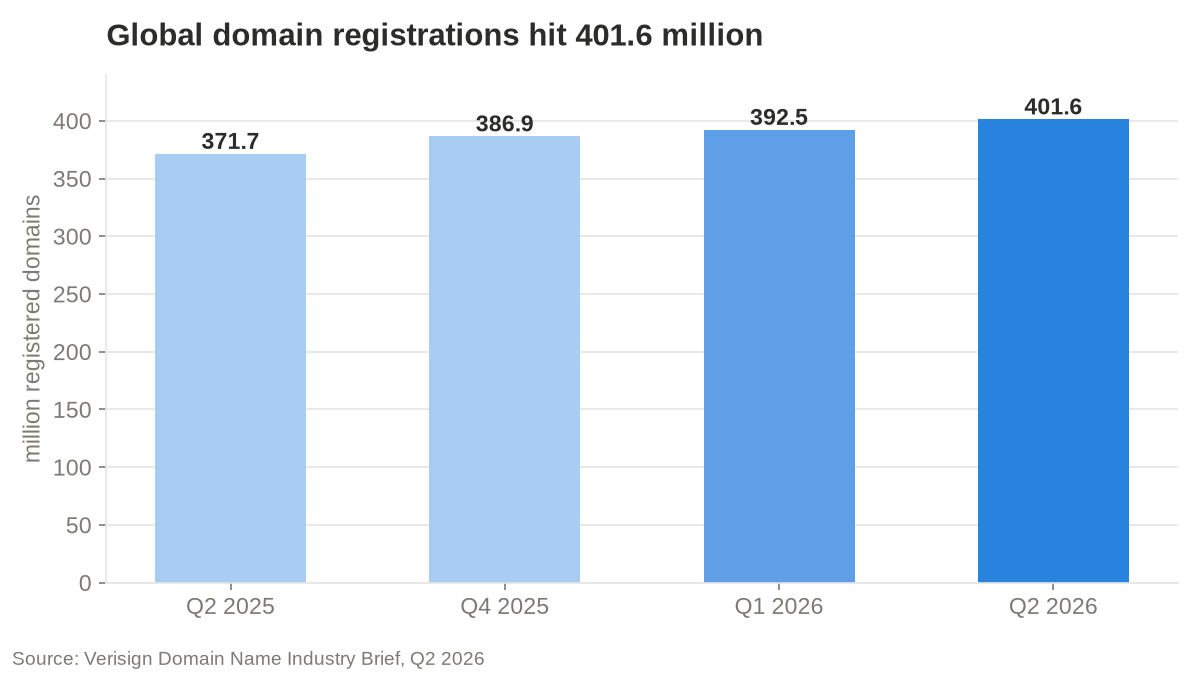
Chart of global domain registration growth through Q2 2026
The Verisign Domain Name Industry Brief counts 401.6 million registered domains as of Q2 2026, up 8.1 percent year over year with consistent quarterly growth. The consequence, good short names are disappearing fast. If you find a name that fits and is still available, secure it now.
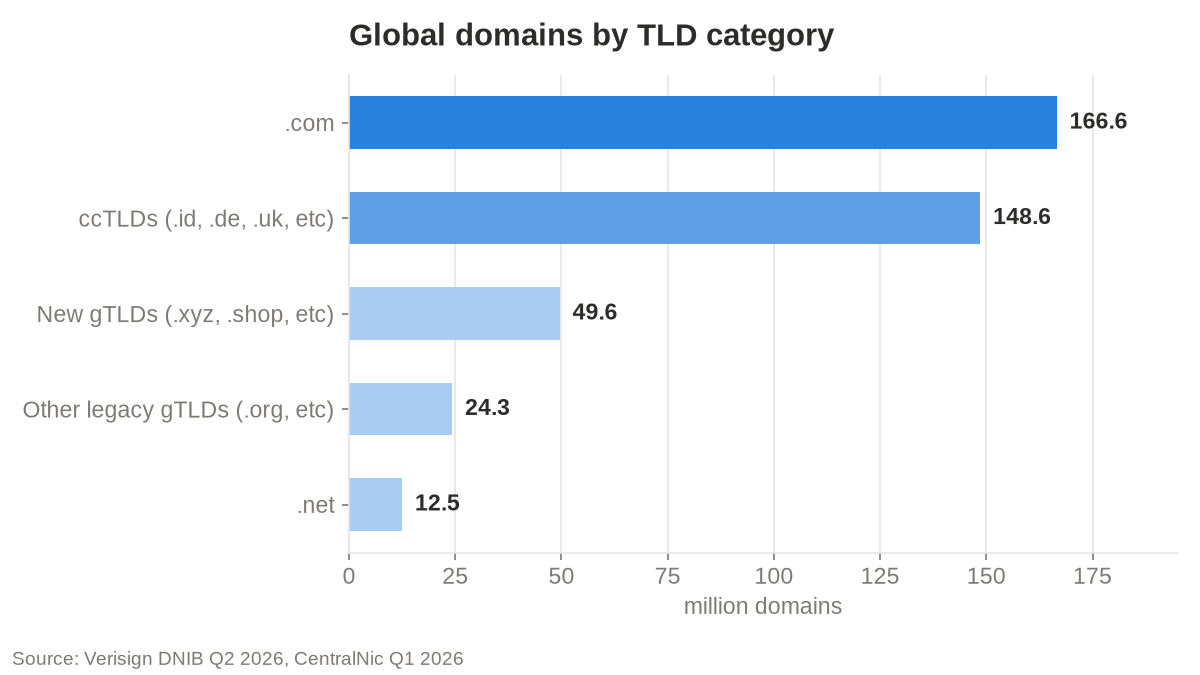
Chart of global domains by TLD category
.com still leads with 166.6 million registrations, followed by country code TLDs at 148.6 million. New gTLDs like .xyz and .shop are the fastest growing category, up 31.3 percent per year based on Q1 2026 data.
Types of Domains and Examples
The extension you choose shapes how visitors perceive your site before they even open it. These are the five types to know before you decide.
Type | Description | Examples |
|---|---|---|
gTLD | Generic global extensions | .com, .org, .net |
ccTLD | Country code extensions | .id, .jp, .de, .uk |
New gTLD | Newer thematic extensions | .xyz, .shop, .store |
Second level domain | Layered extensions | |
Subdomain | The part before the main domain |
For most businesses the safest combination is .com for global reach plus your local ccTLD for regional trust. Two extensions cost very little compared to the risk of your brand name ending up in someone else's hands.
Tips for Choosing a Domain Name
Short and easy to spell. A name you have to spell out twice on the phone is a bad name.
Consistent with your brand name so people can remember and search for it.
Avoid numbers and hyphens, both cause typos.
Prefer .com for global markets. For an Indonesia-focused business, .id or .co.id adds local signal and trust.
Secure multiple extensions at once to protect your brand.
How to Register a Domain
Check name availability at a registrar such as Namecheap, GoDaddy, or Cloudflare Registrar.
Choose a registration period, at least one year.
Enable WHOIS privacy protection so your personal data is not exposed.
Point the domain to your hosting through DNS settings.
Turn on auto renew. A forgotten domain can be taken by someone else and destroy the SEO you built.
FAQ
What is the difference between a domain and hosting?
The domain is the address, hosting is the land and building. The domain directs visitors, hosting stores your website files.
What is the difference between a domain and a URL?
A domain is just the site name, like soedja.com. A URL is the full address of one specific page, like soedja.com/blog/what-is-a-domain. Read the full breakdown in what is a URL.
Does the domain extension affect SEO?
Google treats popular gTLDs equally. ccTLDs like .id add a geographic signal that helps with local targeting. What matters far more is content quality and your SEO strategy.
What is a subdomain?
A subdomain is an extra part in front of the main domain, like blog in blog.soedja.com. It is typically used to separate sections of a site such as a blog, a store, or a dashboard without buying a new domain.
How much does a domain cost per year?
A .com typically runs 10 to 15 USD per year, ccTLDs sit in a similar range or slightly above. Watch the renewal price, it is often higher than the first-year promo.
Conclusion
Your domain is the first digital identity prospects see, and the market grows 8.1 percent per year. Pick a short name that matches your brand, then secure it before someone else does. Once the domain is ready, the real battle is content and distribution. The Soedja team can help through our performance ads service, and you can start keyword research with Soedja's free tools.
Editorial Team