





An insight is a deep understanding gained after analyzing data and information, so you know why something happened and what action to take. Insight differs from raw data. Data records what happened, an insight explains why and opens a path to act.
Quick summary
An insight is a meaningful, actionable conclusion drawn from data.
Data, information, and insight are three different, sequential things.
Insight-driven organizations win on acquisition, retention, and profit.
Insights do not require big data, customer reviews and ad data qualify too.
The quality of an insight depends on the question asked, not the amount of data.
What Is an Insight?
An insight is an understanding of the cause behind a phenomenon, reached by observing and analyzing facts. In business and marketing it has one extra requirement, it must be actionable. If a finding does not change any decision, it is still information, not an insight.
Instagram Insights, for example, is an account statistics dashboard. Those numbers are data. The real insight is the conclusion you draw from them.
Data vs Information vs Insight
Level | Definition | Example in digital ads |
|---|---|---|
Data | Raw facts without context | Ad A CTR 0.8%, Ad B CTR 2.1% |
Information | Processed data with context | Ad B performed 2.6x better this month |
Insight | Actionable understanding of the cause | Ad B won because it opens with the customer's problem, not product features. All future creatives should start from the problem |
Data answers what, information answers how much, insight answers why and what next. Most businesses stop at information, dashboards full of numbers while decisions still run on gut feeling.
Why Do Insights Matter for Business?
Finding | Number | Source |
|---|---|---|
Data-driven organizations vs competitors | 23x more likely to acquire customers, 19x more profitable, 6x better retention | McKinsey Global Institute |
Heavy users of customer analytics | Roughly 2x more likely to beat industry average profit | McKinsey DataMatics |
Global customer analytics market | USD 24.85 billion in 2025, projected USD 123.33 billion by 2034 | Fortune Business Insights |
Global market research industry | Past USD 150 billion, 89% of researchers already use AI tools | Fuel Cycle |
Data-driven organizations are 23x more likely to acquire customers, 19x more profitable, and 6x more likely to retain customers. Source: McKinsey Global Institute. Chart labels in Indonesian, localize before publish.
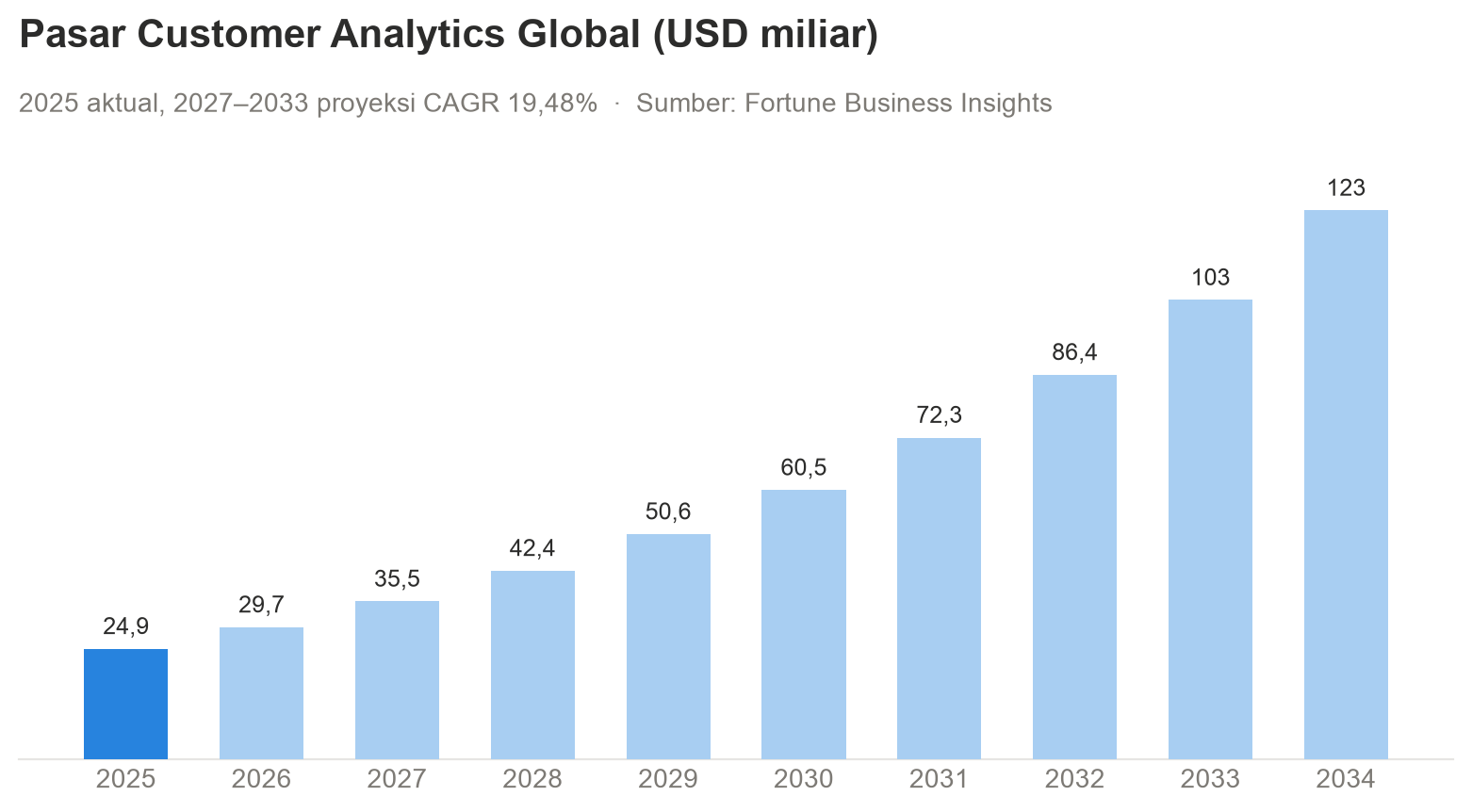
Analytics growing at nearly 20% a year means companies worldwide are racing to turn data into insight. If you do not move, you compete against rivals who know more about your customers than you do.
How Do Brands Use Insights?
Case | Insight found | Result |
|---|---|---|
Netflix | Viewers pick shows through personal recommendations more than search | 80% of viewing comes from recommendations, retention above 90%, personalization saves over USD 1 billion per year |
Amazon | Shoppers add items relevant to their purchase history | About 35% of revenue comes from the recommendation engine |
Dove, Real Beauty campaign | Most women felt unrepresented by beauty ad models | One of the most iconic campaigns ever, repositioned the brand for over a decade |
Soedja education client (illustrative data) | Working professionals and fresh graduates enroll for different reasons, one message does not fit both | After splitting creatives by segment, cost per lead fell from IDR 85,000 to IDR 52,000 in six weeks |
The best insights sound obvious after they are found. The expensive part is the process of finding them and the courage to act.
How Do You Get Insights from Data?
Start from a business question, not from data. Sharp questions determine which data matters.
Collect from relevant sources. Analytics, ad dashboards, reviews, support chats, interviews. Qualitative sources often reveal what numbers hide.
Look for patterns and anomalies. Compare segments, periods, and channels. Insights hide in differences, not averages.
Test with why, then act. If a finding changes no decision, it is not an insight yet. Turn it into an experiment, measure, repeat.
One key principle, insights do not need big data. Ten customer reviews read seriously often beat a dashboard with a hundred unanalyzed metrics.
The Fastest Source of Insights: Your Own Ads
If you already run ads, your campaign data is the nearest source of insights. Soedja's free ads analysis tool reads your ad performance and shows what is healthy and what needs fixing. For the full picture of results-based advertising, read our complete performance marketing guide.
Frequently Asked Questions
What is the difference between insight and analysis?
Analysis is the process, insight is the outcome. Analysis without insight happens all the time, usually because it stops at describing numbers.
What is Instagram Insights?
A statistics feature for professional accounts covering reach, engagement, and audience demographics. Those numbers are raw material. The real insight is your conclusion from them.
Do insights require big data?
No. Five customer interviews, one review column, or one small campaign can produce insights. What matters is the quality of the question and honesty in reading the data.
What is a customer insight example?
The classic one, customers do not buy a drill because they want a drill, they want a hole in the wall. In practice it can be as simple as discovering most of your buyers check out on mobile after 8 pm, so your ad schedule should adjust.
Is an insight the same as an idea?
No. An idea is a proposed action, an insight is the understanding that justifies it. Strong ideas are usually built on top of a real insight.
Conclusion
An insight is a data-driven understanding sharp enough to change a decision. The business case is clear, insight-driven organizations outperform on acquisition, retention, and profit.
Start where you are. Download the free templates, run your ads through the free analysis tool, or let the Soedja Performance Ads team turn insights into campaigns. The first consultation is free.
Founders at Soedja