





A web development agency in Indonesia covers planning, design, development, and launch for businesses that need a serious web presence in the Indonesian market, from a company profile to a full e-commerce platform. For foreign companies the appeal is a combination few markets offer. Deep local market knowledge, rates well below Western agencies, and a digital economy that keeps compounding.
This guide covers what changes when you build for Indonesia, what fair pricing looks like, how a professional process runs, and the compliance details foreign teams usually miss.
Quick summary
Indonesia's e-commerce GMV reached USD 65 billion in 2024 and is projected to hit USD 150 billion by 2030
221.5 million Indonesians are online, and most of them browse and buy on mobile
Fair pricing ranges from around USD 200 for a template landing page to USD 19,000 and up for custom e-commerce
Local payments, mobile performance, and PSE registration are the requirements foreign teams most often underestimate
Organic search drives around 53% of website traffic, so SEO belongs in the build, not after it
Why Indonesia Is Worth Building For
Indonesia is the largest digital economy in Southeast Asia and it is still accelerating. The market that websites compete in is growing fast enough that the build decisions you make now determine whether you can capture that growth later.
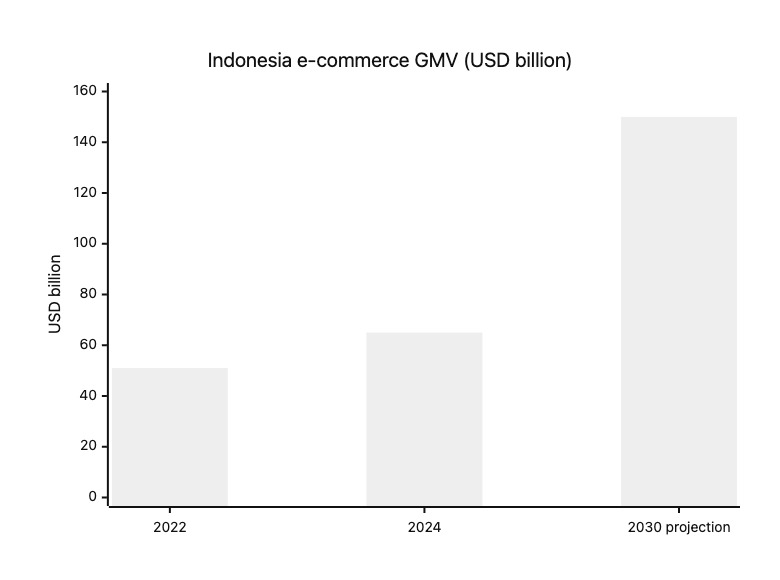
Source: e-Conomy SEA 2024 report, Google, Temasek, Bain & Company.
The audience is already here. Indonesia has 221.5 million internet users, a penetration of 79.5% of the population according to APJII 2024. And first impressions carry unusual weight. Stanford's Web Credibility Research found that 75% of users judge a business's credibility from its website design. If you are a foreign brand entering the market, your website is often the only credibility signal a local buyer has.
What Local Context Changes About Web Development
This is where a translated version of your home-market website fails. Indonesian users pay differently, browse differently, and are protected by different regulations. A good local agency treats all of this as core scope.
Local requirement | What it means for your build |
|---|---|
Payment methods | Indonesian buyers pay with bank virtual accounts, QRIS, and e-wallets like GoPay, OVO, and DANA. Credit card penetration is low. Gateways such as Midtrans or Xendit must be in scope, not a hidden add-on |
Mobile performance | Most users browse on mid-range Android devices over 4G. Per Google/SOASTA research, 53% of mobile visits are abandoned when a page takes more than 3 seconds |
Language | Bahasa Indonesia content is non-negotiable for consumer audiences. English works as a secondary layer for B2B |
PSE registration | Online platforms operating in Indonesia are required to register as an Electronic System Operator (PSE) with the ministry overseeing digital affairs. Foreign teams rarely know this exists until it blocks them |
Hosting and latency | Serving from Jakarta or Singapore regions keeps load times acceptable for Indonesian users. A US-hosted site feels slow here |
None of these are exotic problems. They are solved daily by teams who build for this market. The risk is hiring a team that has never had to solve them.
How Much Does Web Development Cost in Indonesia?
Four variables drive the price. How custom the design and build are, how complex the features get, who does the work, and what happens after launch. With those variables in mind, fair market ranges in 2026 look like this.
Project type | Typical range | Usually for |
|---|---|---|
Template-based landing page | USD 200 to 650 | Product validation, ad campaigns, simple business profiles |
Custom company profile | USD 650 to 2,200 | Service and B2B businesses that need credibility and structured service pages |
Standard e-commerce | USD 1,600 to 4,700 | Online stores with a catalog, payment gateway, and shipping integration |
Custom e-commerce or web app | USD 4,700 to 19,000 and up | Specific requirements, internal system integration, high traffic scale |
These are market estimates, not a price list. Comparable scope from a US, UK, or Singapore agency typically runs three to ten times higher, which is why Indonesia has become a serious option for companies that want custom work without enterprise pricing.
The same warning applies here as anywhere. If an offer comes in far below these ranges, the cost has not disappeared, it has moved. Usually into unmaintainable code, poor performance, or a structure you will have to rebuild once you get serious about SEO and paid acquisition. A cheap website you rebuild a year later is the most expensive website you can buy.
What a Professional Process Looks Like
A serious agency will not send a price before understanding your business. The process should look roughly like this.
Discovery. Business goals, target audience, and success metrics. One to two weeks
Sitemap and wireframes. Page structure and layout skeletons agreed before visual design starts. SEO foundations belong at this stage
Design. Page-by-page visual design, reviewed and revised together
Development. The design becomes a working website, including payment and system integrations
QA and content migration. Cross-device testing, performance checks, and content entry
Launch and maintenance. Go-live, monitoring, and a clear agreement on who maintains the site
A company profile usually takes four to eight weeks, e-commerce two to four months. Working remotely with an Indonesian team is straightforward. Jakarta runs on GMT+7, which overlaps cleanly with the entire APAC workday and leaves a morning window for Europe. Expect written, async-friendly communication in English from any agency used to international clients.
Why SEO Belongs in the Build
Organic search drives around 53% of all trackable website traffic according to BrightEdge Research, more than any other channel. And position on the results page decides almost everything.
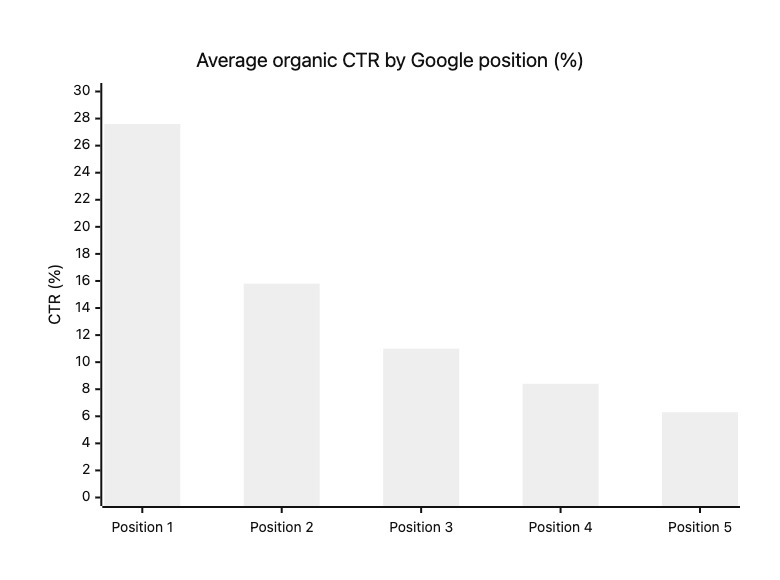
Source: Backlinko, organic CTR study based on 4 million Google search results.
SEO is cheapest when it is designed into the site and most expensive when it is bolted on later. URL structure, page hierarchy, performance, and structured data are architecture decisions, not patches. When we rebuilt the website for Fitquarters, an Indonesian gym management platform, the SEO-first architecture came before a single article was written, and that foundation is what made the later SEO and paid campaigns work. The full breakdown is in the Fitquarters case study.
Frequently Asked Questions
How much does web development cost in Indonesia?
Fair ranges run from USD 200 to 650 for a template landing page, USD 650 to 2,200 for a custom company profile, and USD 1,600 to 19,000 and up for e-commerce depending on feature complexity and integrations.
How long does a project take?
A company profile usually takes four to eight weeks, e-commerce two to four months. A much faster promise usually means a skipped stage, most often discovery or QA.
Can we work with an Indonesian agency remotely?
Yes. Agencies serving international clients work in English, communicate async, and operate on GMT+7, which overlaps well with APAC and partially with Europe. Agree on tools and reporting cadence in the contract.
Who owns the code, domain, and data?
You should. Make sure the contract states that the domain, code, content, and hosting access are registered under your business, not the vendor's.
Do we need PSE registration?
If your platform serves Indonesian users and processes their data or transactions, most likely yes. A capable local agency will raise this early instead of leaving you to discover it after launch.
Conclusion
Building for Indonesia rewards teams that respect the local context. Payments, mobile performance, language, and compliance are not localization chores, they decide whether the site converts at all. Price reflects how much of that context is actually in scope, and now you know what fair scope looks like.
At Soedja we build websites starting from one question, how the asset will drive growth, not just how it looks. You can see that SEO-first approach in the Fitquarters case study, and if you are evaluating vendors, our free analysis tools can benchmark your current site. For a deeper conversation, the Soedja team is open for consultation, the first one is free.
Editorial Team