


Copywriting is the craft of writing marketing text, known as copy, designed to persuade readers to take one specific action. That action can be buying a product, filling in a form, subscribing to an email list, or clicking a button. What separates copy from ordinary writing is that every sentence has a job, which is moving the reader one step closer to that action.
Summary for busy readers
Copywriting is writing to persuade, not just to inform. Success is measured by how many readers act, not by how pretty the prose is.
Good copy moves money directly. Personalized CTAs convert 202% better than generic ones according to a HubSpot study.
Email marketing, a channel that lives or dies by copywriting, returns $36 to $42 for every $1 spent.
Formulas like AIDA and PAS mean you never have to write from scratch. Start with the formula, then improvise.
In the AI era copywriting matters more, not less, because both machines and humans reward clarity, structure, and proof.
What is copywriting?
Copywriting is the process of writing marketing and sales material that drives people to take action. The person who does it is a copywriter, and the output is called copy. Copy is everywhere, from ad headlines, landing page text, and email subject lines to the tiny words on buttons like "Start Your Free 14-Day Trial".
The term is often confused with content writing. Both involve writing, but they point in different directions.
Aspect | Copywriting | Content writing |
|---|---|---|
Main goal | Persuade the reader to act now | Educate and build long-term trust |
Common formats | Headlines, ads, landing pages, sales emails, CTAs | Blog articles, guides, educational newsletters |
Length | Usually short and dense | Usually long and in-depth |
Success metric | Conversions, clicks, sales | Traffic, rankings, engagement |
In practice the two roles complete each other. A great SEO article needs copywriting in its title and CTA, and a great ad needs deep content understanding. If you want the traffic side of the equation first, read our guide on SEO.
Why does copywriting matter for business?
Because the words you choose change your conversion numbers directly, without adding a single dollar to your ad budget. Two data points show the scale of the impact.
First, look at email marketing. This channel is almost entirely determined by copy quality, from subject line to CTA, and its ROI leaves every other channel behind.
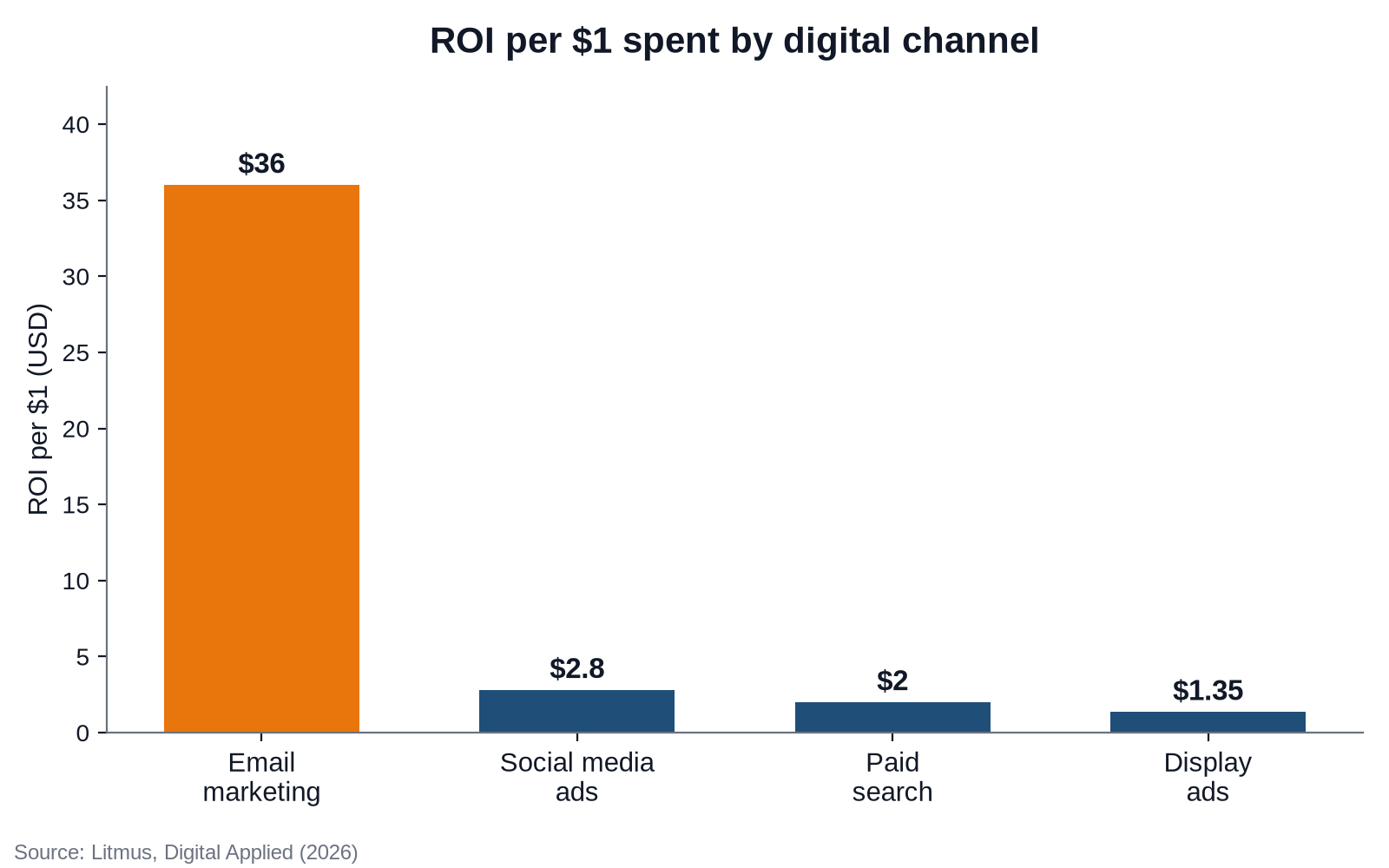
ROI per dollar spent by digital channel. Email marketing towers over paid channels.
Email returns an average of $36 per $1 spent, while paid search returns around $2 and display ads $1.35. Around 52% of consumers have bought directly from an email. That makes writing emails that get opened and clicked one of the most profitable skills in digital marketing.
Second, small copy improvements produce outsized conversion jumps.
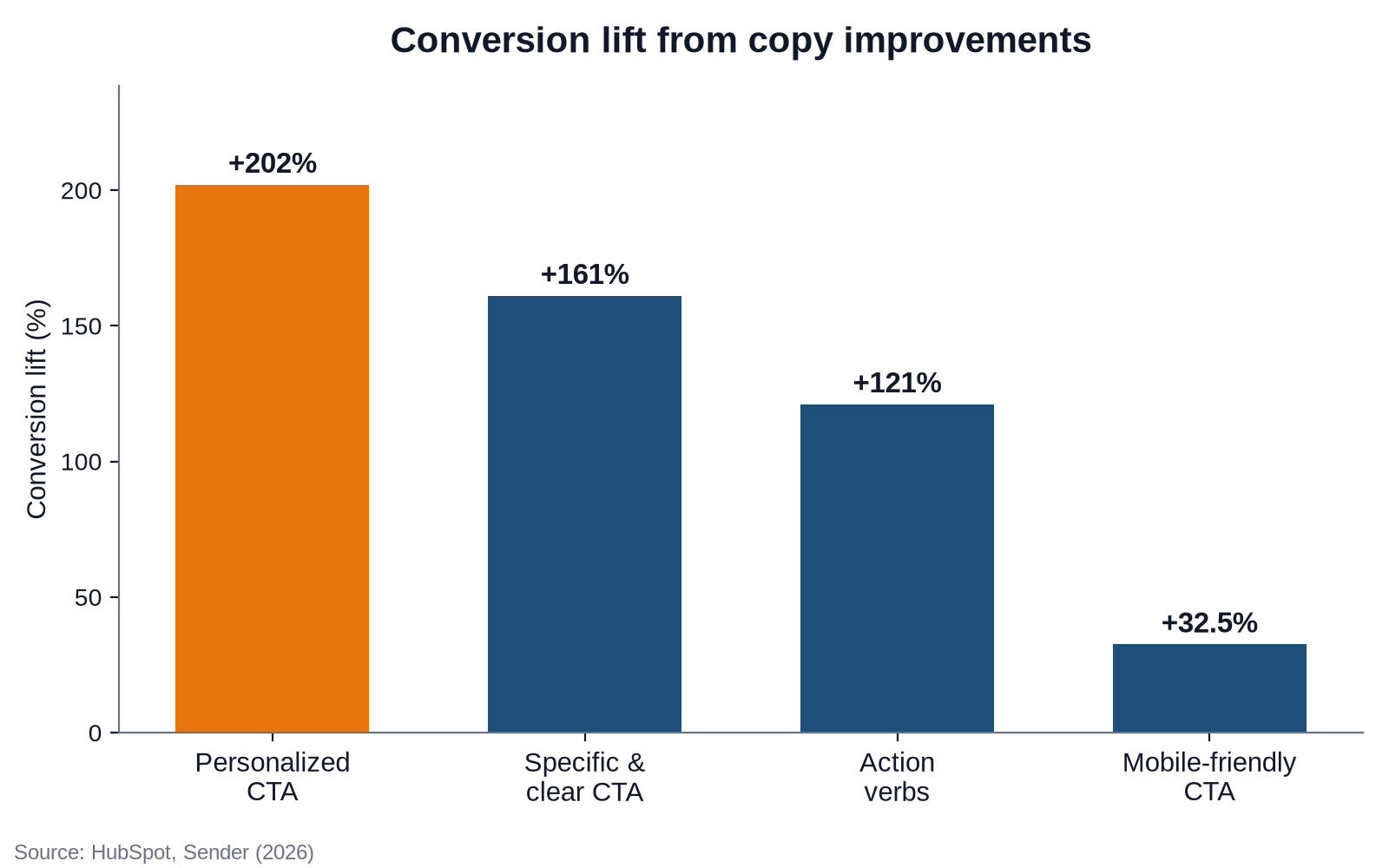
Conversion lift from copy improvements. Personalized CTAs lift conversions by 202%.
HubSpot's study of more than 330,000 CTAs found that personalized CTAs convert 202% better than generic ones. Specific, clear CTAs lift conversions by up to 161%, and simply using action verbs like "start" or "claim" can add 121%.
One more thing people underestimate is basic writing quality. A Real Business survey found 59% of consumers would avoid buying from a company whose website contains obvious spelling and grammar mistakes. Sloppy copy is not just ugly, it kills sales.
What are the types of copywriting?
Copywriting is not one uniform job. The type changes with the channel and the goal.
Type | Focus | Example output |
|---|---|---|
Direct response | Immediate action right now | Sales pages, ads with a buy-now CTA |
Brand copywriting | Building brand image and voice | Taglines, brand manifestos, campaign scripts |
SEO copywriting | Writing for humans and search engines at once | Article titles, meta descriptions, pillar content |
Email copywriting | Open rates and clicks from the inbox | Subject lines, email sequences, sales newsletters |
Ad copywriting | Attention within seconds | Meta Ads copy, Google Ads copy, short video scripts |
UX writing / microcopy | Guiding users inside a product | Button labels, error messages, onboarding |
For small and medium businesses, the three most needed types are SEO copywriting for articles, ad copywriting for paid campaigns, and email copywriting for nurturing leads. All three belong inside a complete digital marketing strategy.
Which copywriting formulas actually work?
Professional copywriters rarely start from a blank page. They use formulas proven over decades, then adapt them to the context.
Formula | Structure | Best for |
|---|---|---|
AIDA | Attention, Interest, Desire, Action | Landing pages and general ads |
PAS | Problem, Agitate, Solution | Sales emails and social media ads |
BAB | Before, After, Bridge | Case studies and transformation copy |
FAB | Features, Advantages, Benefits | Product descriptions and feature pages |
4U | Useful, Urgent, Unique, Ultra-specific | Headlines and email subject lines |
My advice is to master AIDA and PAS first. Those two cover 80% of everyday business copy needs.
How do you write copy that sells?
The process comes down to five steps.
Research the audience first, write later. Collect the exact language your buyers use in reviews, comments, and support chats. The best copy is usually quoted from customers, not invented.
Pick one action you want. One page, one goal. Ask readers to buy, subscribe, and follow all at once and they will usually do nothing.
Spend more time on the headline than the body. The headline decides whether anything else gets read.
Structure the body with a formula. Start from the reader's problem, not from how great your product is.
Edit ruthlessly. Cut every word that adds no meaning. Good copy feels effortless to read to the end.
The headline: 8 out of 10 people stop here
David Ogilvy famously said that once you have written your headline, you have spent 80 cents of your dollar. On average 8 out of 10 people read the headline, but only 2 out of 10 read the rest. So the headline must promise a specific benefit. "An Email Marketing Guide" is weak next to "How to Write Emails That 40% of Your Subscribers Open".
Body copy: sell benefits, not features
A feature is what your product has. A benefit is what your reader gets. "A 200 MP camera" is a feature. "Product photos that look professional without hiring a photographer" is a benefit. Structure the body as an inverted pyramid with the most important information at the top, because most people scan instead of reading.
The CTA: personal, specific, one action
The chart above says it all. Personalized CTAs win by 202% and specific CTAs by 161%. In practice, replace "Submit" with "Send My Quote Request", and match the CTA to the reader's stage. First-time visitors get invited to read a guide, returning visitors get invited to book a consultation. This is also why CTR can differ wildly between ads for the same product.
Where does copywriting fit in SEO and the AI era?
It is becoming more important, not less. In SEO, copywriting decides whether people click your search result and keep reading. Your title tag and meta description are essentially free ads on Google's results page.
In the AI search era of Google AI Overviews and ChatGPT, the answers machines quote are the ones written clearly, structured well, and straight to the point. That is a copywriting skill. Rambling text gets filtered out faster than ever because machines summarize and readers grow impatient.
On AI as a writing tool, the data is interesting. AI-generated subject lines have been reported to lift open rates by up to 26% compared with manually written ones. But AI works best as a first-draft engine and an A/B variation machine. Message direction, audience insight, and final judgment remain human work. Copy that sounds like a machine erodes trust.
Which metrics measure copywriting?
Copywriting is measurable. If you do not measure it, you will never know which copy works.
Metric | What it measures | Copy that influences it |
|---|---|---|
CTR | Percentage of people who click after seeing | Headlines, SEO titles, ad copy |
Conversion rate | Percentage of visitors who take the action | Body copy, CTA, the offer |
Open rate | Percentage of emails opened | Subject line and sender name |
CTOR | Clicks divided by opened emails | Email body and its CTA |
Bounce rate | Visitors who leave without any action | How well the headline matches the page |
The workflow is simple. Write two versions, run an A/B test, keep the winner, repeat. Median landing page conversion rates sit around 4 to 6.6%, so if your page is below 2%, the copy or the offer is almost certainly the problem. Better ad copy also lowers your CPC because relevance goes up.
The most common copywriting mistakes
Talking about yourself the whole time. Copy full of "we are a leading company" never answers the reader's real question, which is what is in it for me.
Selling features instead of benefits. Specs matter, but buying decisions are driven by outcomes the buyer can feel.
Generic CTAs. "Submit" and "Click here" throw away the 161% lift that specific CTAs deliver.
Asking for too much on one page. Buy, follow, subscribe, and download all at once confuses readers into doing nothing.
Flowery language and jargon. Good copy sounds like a human explaining to a friend, not a corporate brochure.
Never testing. Without A/B tests you are guessing. The companies that win on conversion are the most disciplined testers, not the best wordsmiths.
Copywriting tools worth using
Google Docs or Notion for drafting and collaborating with your team.
Hemingway Editor for cutting long, complicated sentences.
Ubersuggest or Google Keyword Planner for researching the words people actually search.
ChatGPT, Claude, or Gemini for first drafts and A/B variations, as long as a human edits the output.
Google Analytics and A/B testing tools like VWO to prove which copy wins.
You can also find free calculators and helpers at soedja.com/tools.
Copywriting FAQ
What does a copywriter actually do?
Research the audience and product, write copy for channels like ads, email, and landing pages, then test and revise based on performance data. The research often takes more time than the writing.
What is the difference between copywriting and content writing?
Copywriting persuades readers to act now, for example to buy or sign up. Content writing educates to build long-term trust. Copywriting is measured in conversions, content writing in traffic and engagement.
Which formula is easiest for beginners?
PAS. State the reader's problem, sharpen the urgency, then offer your solution. It almost always works for email and social media ads because it follows how people already think about their own problems.
Can you learn copywriting without a writing background?
Yes. Copywriting is closer to sales psychology than literature. Listening to customers and thinking in structures matters more than a gift for beautiful sentences.
Will AI replace copywriters?
AI replaces the drafting, not the thinking. The safest copywriters are the ones using AI to speed up production while still owning strategy, audience research, and quality control.
How long should copy be?
Exactly as long as it takes to convince, and no longer. Cheap, impulsive products need short copy. Expensive, high-risk products need long copy that answers every objection.
Conclusion
Copywriting is the highest-leverage skill in digital marketing. Words cost the same either way, but the results can differ by hundreds of percent, as the 202% lift from personalized CTAs shows. Start with one thing, pick the most important page on your website, rewrite its headline and CTA using the principles above, then compare the numbers after two weeks.
If you would rather have your ad and landing page copy written and measured by a team that lives and breathes performance marketing, the SOEDJA team can help through our performance ads service. The consultation is free, just tell us your business goals first.
Editorial Team