




TikTok is turning comment sections from a place for short reactions into a richer interaction layer. Its latest update introduces voice comments, polls, photo carousels with up to nine images, and Live Photo comments.
For audiences, this means expression is no longer limited to text, emojis, or a single image. People can communicate tone of voice, document experiences visually, and directly influence a creator’s next decision.
For brands, the comment section can become much more than a customer service queue. It can support audience research, content validation, product development, community activation, and stronger human relationships.
The biggest opportunity is not simply generating more comments. It is making audiences feel that their participation can shape what the brand does next.
TikTok comments are becoming an experience of their own
On September 3, 2026, TikTok introduced four comment updates in Say More in the Comments.
Voice Comments allow users aged 18 and older to record messages up to 60 seconds. Comment Polls let creators add up to five options and set a voting period. Photo Carousel Comments increase the capacity of one comment from one photo to nine. Live Photo Comments add a brief burst of motion to visual responses.
These may look like small product changes, but they point to a larger shift. TikTok wants the conversation beneath a video to become part of the content rather than a reaction that happens after the content ends.
The scale already exists. TikTok says more than 1.7 billion comments are shared every day. When a space this large gains richer audio, voting, and visual formats, brands gain more ways to understand and involve their audiences.
From the audience perspective, comments can shape content
People comment when they have something to add, but text cannot always carry enough emotion, detail, or context.
Voice Comments reduce that limitation. Laughter, excitement, hesitation, and tone become audible. For food, music, entertainment, beauty, parenting, travel, and hobby communities, a voice response can feel more personal than typed text.
Photo Carousel Comments give audiences more room to provide proof and tell a story. People can show several ways to use a product, before-and-after results, different colors, a travel experience, or the process of testing a recipe. The capacity rises from one photo to nine photos in a single comment.
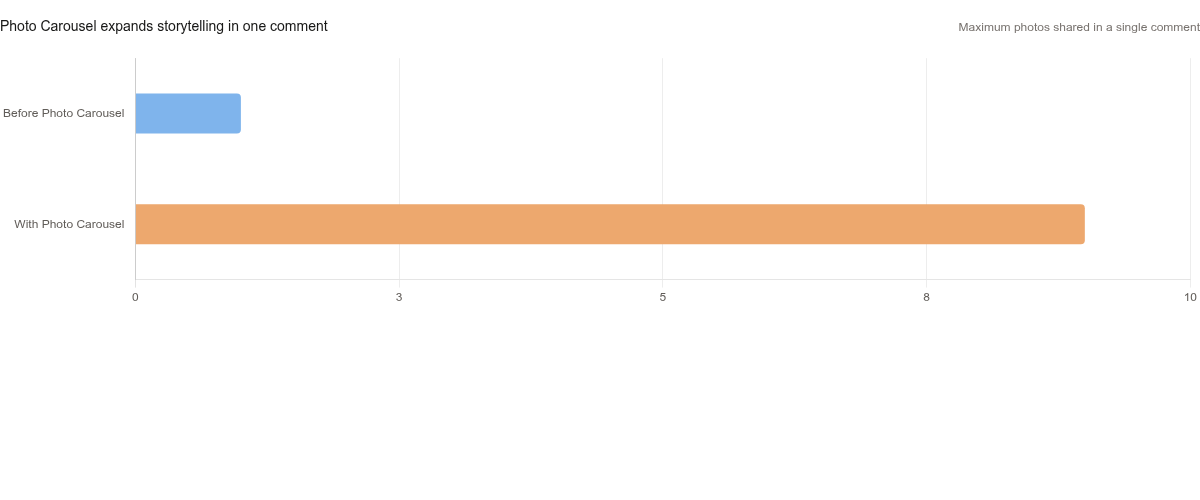
Photo Carousel Comments increase the maximum capacity from one photo to nine photos in a single comment.
Comment Polls give audiences a more active role. They can vote on the next video, a new flavor, packaging, color, outfit, menu, community challenge, or question the brand should answer.
Participation becomes more valuable when it has a visible consequence. If the winning option becomes the next piece of content or a product prototype, the audience sees that its input matters.
A good audience experience therefore feels like a conversation: the brand asks, listens, responds, and shows what happened because people participated.
From the brand perspective, comments become a direct insight source
Many brands still treat comments as a metric or a support task. Teams count them, answer simple questions, hide spam, and move to the next post.
TikTok’s update expands that role. Polls can support lightweight research before production. Voice Comments reveal the words and emotions customers naturally use. Photo carousels show how products are used in real life. Repeated questions can inform a content calendar, FAQ, product page, and service improvements.
TikTok Marketing Science data shows that 68% of surveyed users in the United States, United Kingdom, and Canada believe brands should use comment sections to better understand consumers. The figure is not automatically representative of every market, but it signals a growing expectation: audiences want brands to read the conversation, not only broadcast messages.
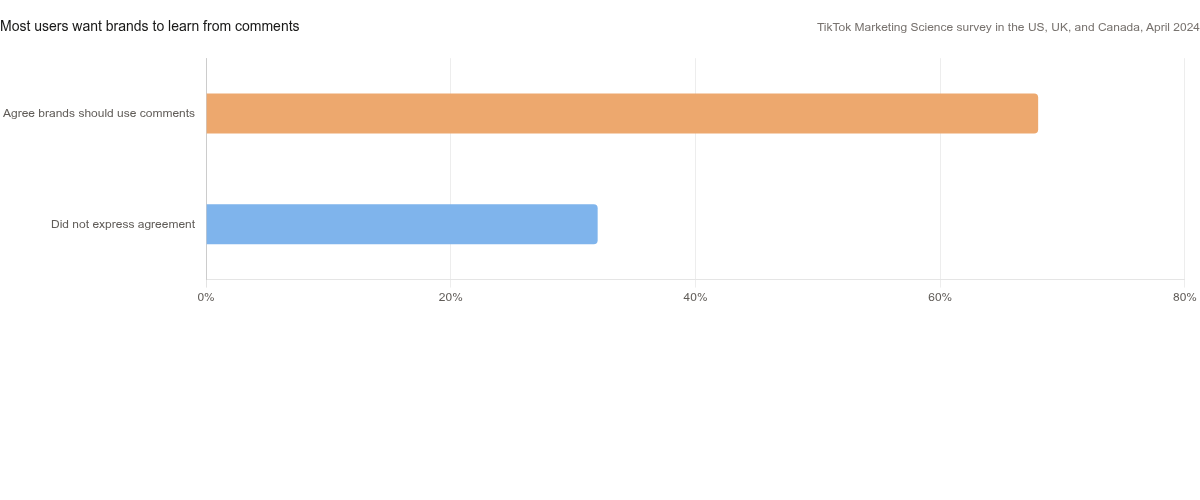
In a TikTok survey across the US, UK, and Canada, 68% of users said brands should use comments to understand consumers.
Commenting also allows brands to show personality at a relatively low production cost. A video can require a concept, talent, shooting, and editing. Dozens of useful responses can be created without the same production workload.
Low cost does not mean careless execution. Replies still require a consistent tone, contextual judgment, and clear boundaries. The goal is not to make a joke in every conversation. It is to be useful and relevant when the brand has something worth adding.
Polls can turn engagement into decisions
Comment Polls are the easiest feature to connect with a marketing workflow. Before production, a poll can help select topics, formats, or guests. Before a launch, it can test colors, names, features, flavors, or bundles. After launch, it can identify what people liked and what remains unclear.
Poll results are directional signals from people who saw and chose to engage with a post, not representative market research. Brands should use them to form hypotheses and prioritize experiments rather than as the only basis for major decisions.
The engagement becomes more meaningful when brands close the loop. If the audience chooses topic A, the next post should explain that it was produced because topic A won. Without a visible follow-up, a poll can become cosmetic engagement.
This connects directly with personalization in marketing: audiences provide signals, and brands use those signals to make the next experience more relevant.
Voice Comments add closeness and new risks
Voice can make communities feel more alive. Music brands can invite fans to sing a short line. Food brands can ask for taste reactions. Educators can collect spoken questions. Entertainment brands can turn audience audio into future content when clear permission has been obtained.
Voice is also harder to scan than text. TikTok says voice comments are governed by the same Community Guidelines and reviewed using human moderation, automated detection, and speech-to-text transcription.
Brands still need an internal process. Teams should define who monitors audio, how negative comments are escalated, when a case moves to direct messages, and which audience submissions can never be reused.
Do not turn every response into promotional material. Ask permission before using a person’s voice or photos. Transparency protects the trust that creates long-term engagement.
Photo carousels can produce more valuable UGC
One photo usually shows a result. Nine photos can show a process, and process often carries stronger persuasive value.
Beauty brands can observe application from start to finish. Travel brands can receive a complete destination story. Automotive brands can ask users to document modifications. Food brands can see preparation and presentation. Fashion brands can invite several styling variations.
A detailed visual response can also help other prospective customers. The comment section becomes a collection of experiences, demonstrations, and social proof located directly beneath the original content.
Specific prompts produce better UGC. Instead of asking “share your experience,” a brand can ask “show three ways you use this product” or “share the sequence before, during, and after trying it.”
This audience-to-creator shift also relates to how brands use Instagram for business and creator collaboration. The boundary between customer, community member, and creator keeps getting thinner.
Brands need to design the conversation from the start
Engagement should not be added at the end through a generic call to action. The question needs to be part of the content concept.
A video that only says “comment below” transfers too much work to the audience. A specific question with clear choices reduces the effort required to participate.
Useful patterns include:
Let the audience choose the next direction through a poll
Ask people to document an experience through photo carousels
Invite emotional reactions through voice comments
Request evidence or examples from real product use
Collect questions the brand can answer in the next video
Ask audiences to compare two approaches and explain why
The conversation should still feel natural. The principles in this copywriting guide remain relevant because moving too quickly toward a sale reduces the audience’s willingness to participate openly.
Measure more than comment volume
New formats may increase interaction volume, but the number of comments alone does not explain relationship quality.
Useful metrics include relevant-comment rate, poll participation, number of questions answered, new insights identified, actionable UGC, response time, sentiment, profile visits, branded search, clicks, and conversions after interaction.
Brands must also separate noisy activity from valuable engagement. Negative conflict can create a high comment count without building trust. A poll can receive many votes without producing a usable decision. Voice Comments can feel personal but overwhelm an unprepared moderation team.
Healthy engagement appears when audiences return, recognize the brand’s replies, contribute ideas, and help other users. Within a broader digital marketing strategy, comments are one part of the customer journey, not an isolated vanity metric.
Risks brands need to manage
Richer formats create a greater need for governance.
Voice Comments take longer to review. Poorly designed polls can constrain choices and produce bias. Photo carousels may contain irrelevant material, personal information, false claims, or copyrighted content. A playful brand reply can lose its context when reshared.
Brands need guidelines covering tone, response time, customer service escalation, hidden-comment rules, UGC permissions, publishing consent, and sensitive issues.
Clear systems do not have to restrict conversation. They can give teams more confidence because the boundaries and escalation paths are already understood.
The biggest opportunity belongs to brands that close the loop
TikTok’s new comments give audiences more ways to speak and brands more ways to listen.
The advantage will not come from using every feature on every post. It will come from selecting the right format for the objective, responding like a human, and showing how audience input led to action.
From the audience perspective, the best experience is being seen, heard, and taken seriously. From the brand perspective, the biggest value is combining research, content, community, and customer care in one visible interaction layer.
The comment section is no longer an attachment beneath a video. It is becoming a second layer of content and one of the closest meeting points between brands and audiences.
Marketing opportunity summary
New feature | Audience value | Brand opportunity | What to protect |
|---|---|---|---|
Voice Comments | More emotional, personal expression | Collect reactions, stories, questions, and natural audience language | Audio moderation, privacy, and reuse permission |
Comment Polls | Audiences influence decisions | Validate topics, products, formats, flavors, colors, and experiments | Sampling bias and visible follow-up |
Photo Carousel Comments | Tell an experience through up to nine photos | Collect UGC, demonstrations, before-and-after stories, and social proof | Copyright, claims, personal data, and visual quality |
Live Photo Comments | More vivid visual reactions | Capture natural product-use moments | Context, safety, and moderation |
Comment conversations | Interact with brands and other users | Community building, research, customer care, and content ideas | Tone, response speed, and escalation |
Frequently asked questions
What new comment features did TikTok launch?
TikTok introduced Voice Comments, Comment Polls, Photo Carousel Comments, and Live Photo Comments, expanding comments beyond text into audio, voting, and richer visual responses.
How long can a TikTok Voice Comment be?
Users can record a voice comment up to 60 seconds long. The feature is rolling out to accounts aged 18 and older.
How many options can a Comment Poll include?
Creators can add up to five options and set a voting period. The poll is created in the comments beneath the creator’s own video.
How many photos can one TikTok comment contain?
Photo Carousel Comments support up to nine photos in one comment. Previously, photo comments supported one photo at a time.
How can these features improve brand engagement?
They reduce the limits on audience expression and give brands clearer interaction formats. Brands can collect choices, spoken stories, visual evidence, questions, and ideas, then turn them into content or decisions.
Can comment polls replace market research?
No. They provide fast directional signals from an engaged audience, but they are not a representative sample of the full market.
Which metrics should brands monitor?
Track poll participation, comment relevance, sentiment, actionable UGC, response time, profile visits, branded search, clicks, and conversions. Do not rely only on comment count.
What are the main risks of voice and photo comments?
Risks include moderation, privacy, copyright, personal information, false claims, and responses being taken out of context. Brands need governance and permission before reusing audience content.
Sources
TikTok comments are getting more interactive with voice comments, polls, and more, TechCrunch, September 3, 2026
Say More in the Comments: Introducing Voice, Polls, and Carousels on TikTok, TikTok Newsroom, September 3, 2026
TikTok What's Next 2025 Trend Report, TikTok for Business
TikTok What's Next 2025 Trend Report, TikTok Newsroom
Editorial Team