
Personalization is the practice of tailoring experiences, content, or offers to each individual's needs and behavior based on data. The most familiar examples are Netflix recommendations that differ per account and store emails that greet you by name with products you actually viewed.
Quick summary
Personalization means tailoring experiences to each individual based on data.
71% of consumers expect personalized experiences, 76% get frustrated without them.
Personalization can cut acquisition costs by up to 50% and lift revenue 10 to 15%.
Personalization continues the work of segmentation down to the individual level.
The key ingredient is clean first party data, not expensive technology.
What Is Personalization?
The key word is relevant. The same message is never equally valuable to everyone. Personalization uses data such as purchase history, viewed pages, and location to serve what each person is most likely to need at that moment.
One correction worth making, personalization is not just inserting a name in an email subject line. Personalization that moves numbers changes the offer itself, not just the greeting.
How Is Personalization Different from Segmenting?
They belong to the same family at different levels of precision. Segmenting divides a market into groups, personalization tailors the experience down to the individual. In practice it is almost always staged, businesses build clean segmentation first and then move up to personalization. The full explanation of segmentation is in our market segmentation guide.
Aspect | Segmenting | Personalization |
|---|---|---|
Smallest unit | A group of consumers | An individual |
Decision basis | Shared characteristics | Each person's behavioral data |
Example | An email for the new customer segment | Product recommendations based on browsing history |
What Does the Data Say About Personalization?
Finding | Number | Source |
|---|---|---|
Consumers who expect personalized experiences from brands | 71% | McKinsey, Next in Personalization |
Consumers frustrated when experiences are not personal | 76% | McKinsey, Next in Personalization |
Consumers more likely to repurchase after personalized experiences | 78% | McKinsey, Next in Personalization |
Consumers more likely to buy from brands offering personalized experiences | 80% | Epsilon |
Revenue lift from personalization | 10 to 15% | McKinsey |
Customer acquisition cost reduction from personalization | Up to 50% | McKinsey |
Extra personalization revenue earned by faster growing companies vs slower ones | 40% more | McKinsey |
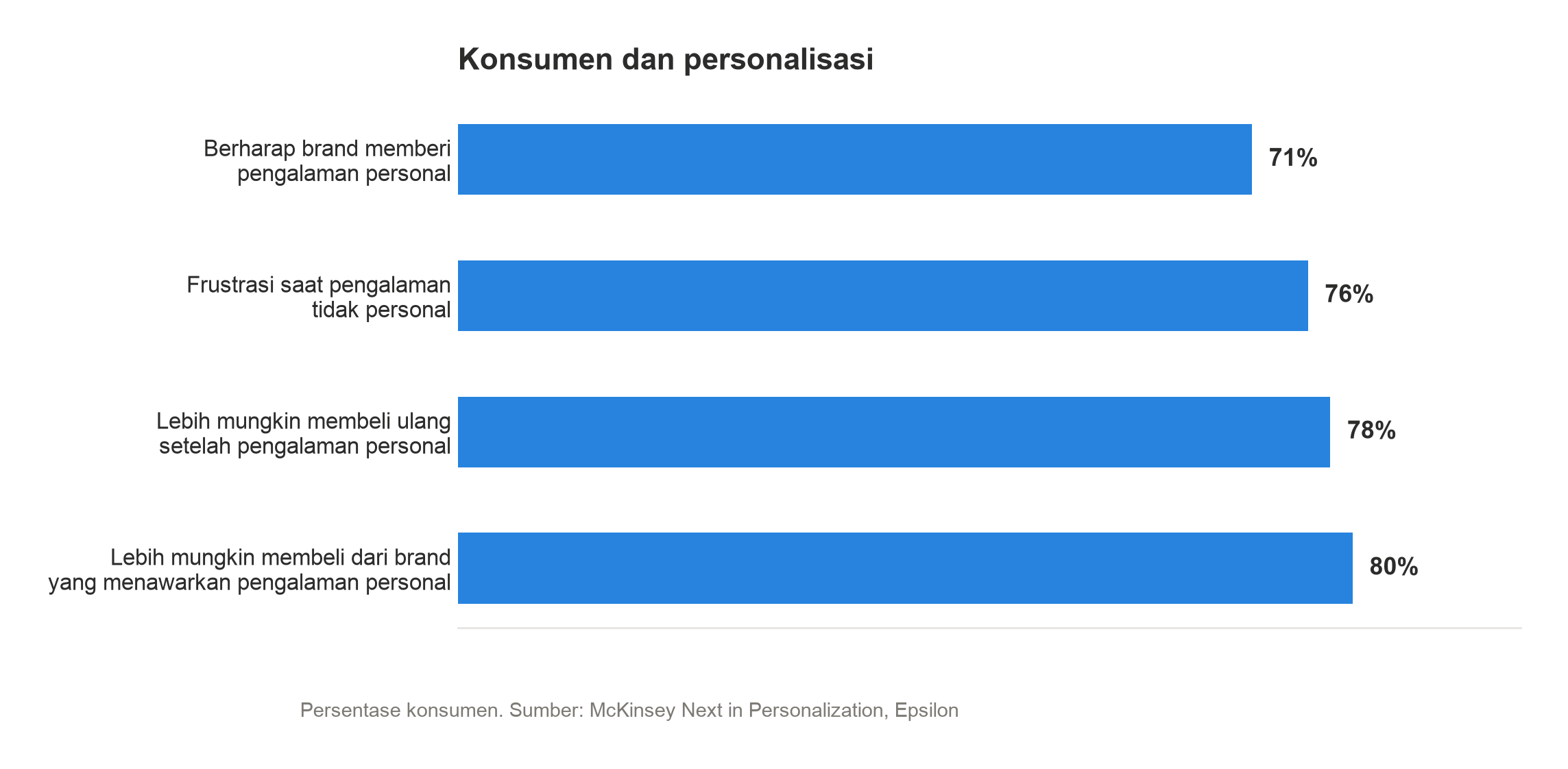
How consumers expect and respond to personalization. Sources: McKinsey, Epsilon. Chart labels in Indonesian, localize before publish.
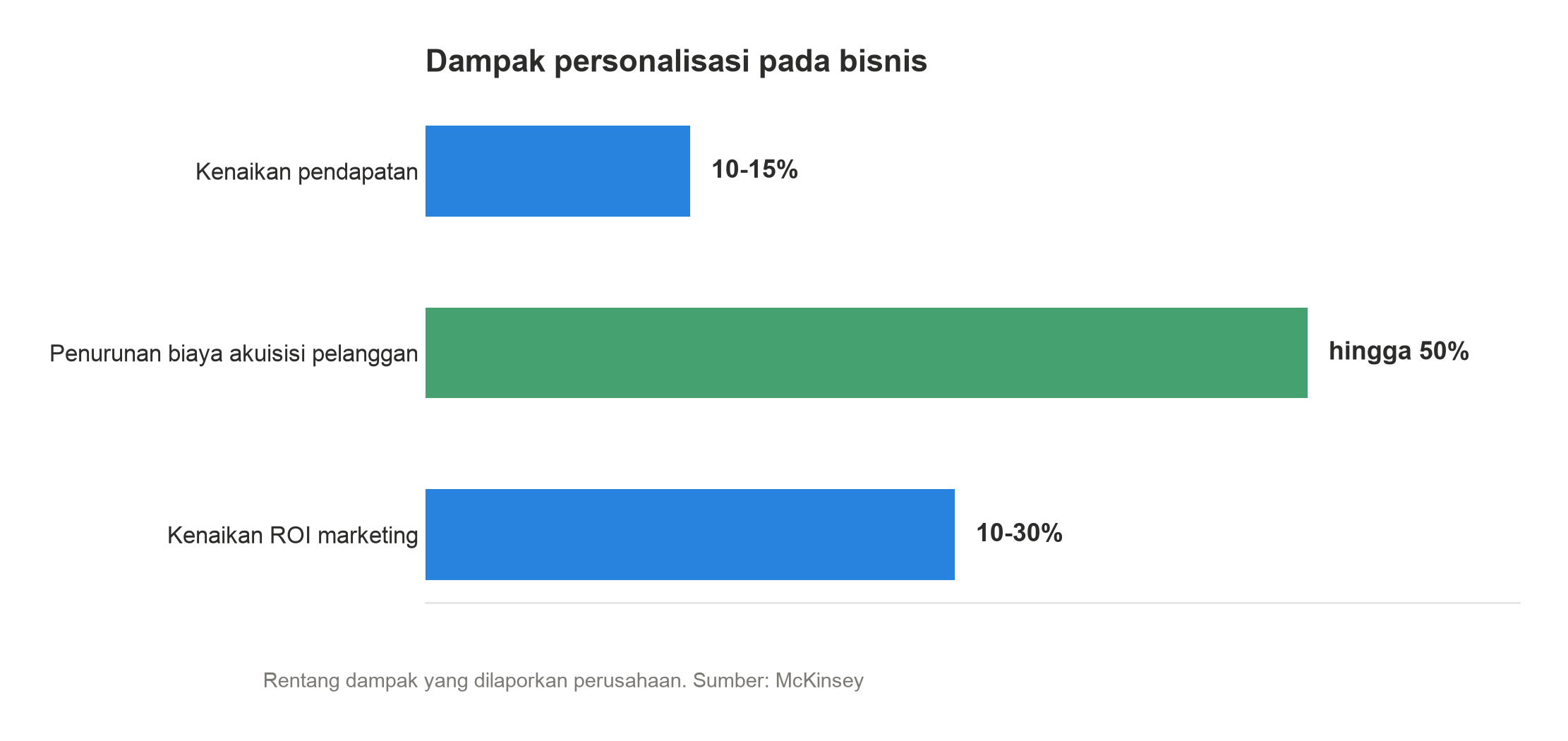
Reported business impact of personalization on revenue, acquisition cost, and marketing ROI. Source: McKinsey. Chart labels in Indonesian, localize before publish.
Look at the 76% frustration number. Personalization has shifted from a nice extra to a baseline expectation. Consumers are no longer impressed when an experience is personal, they are disappointed when it is not.
What Are the Levels of Personalization?
Level | How it works | Example |
|---|---|---|
Mass | One message for everyone, no personalization yet | The same promo broadcast to the whole list |
Per segment | Messages tailored per group | A promo for customers inactive for 90 days |
Per persona | Content follows a more specific needs profile | Different landing pages for business owners and freelancers |
Individual | Experiences assembled in real time per person | Netflix or Amazon style product recommendations |
How Do You Implement Personalization?
Clean up first party data first. Transaction history, website events, and email data are the raw material. Leaky tracking makes personalization miss its target.
Start with segmentation. Split the audience by behavior, this is the foundation before going down to the individual level.
Personalize one touchpoint first. Abandoned cart emails or homepage product recommendations usually show results fastest.
Measure impact against a control. Compare the personalized and generic versions in an A/B test so the lift is proven, not felt.
Expand in stages. Once one touchpoint is proven, repeat the pattern across ads, website, and retention.
What Does Personalization Look Like in Practice?
Case | Finding | Source |
|---|---|---|
McKinsey consumer research | Faster growing companies earn 40% more of their revenue from personalization than slower ones | McKinsey |
Consumer loyalty research | 80% of consumers are more likely to buy from brands that offer personalized experiences | Epsilon |
Soedja e-commerce client (illustrative data) | Generic email blasts replaced with behavior based flows, revenue per email tripled | Soedja |
Free Personalization Templates
All free at soedja.com/tools.
First party data audit checklist before starting personalization
Behavior based email flow templates, from welcome to winback
Touchpoint mapping worksheet to pick what to personalize first
How Does Personalization Relate to Digital Ads?
Modern digital advertising is personalization at scale. Dynamic ads show the exact products a shopper viewed, and data signals decide who sees which offer. All of it only works when tracking and data are healthy. We cover this measurement foundation in the complete performance marketing guide.
Want to know if your ad data is ready for personalization? Run the free ads analysis tool at soedja.com/tools.
Frequently Asked Questions
What does personalization mean?
Personalization means tailoring experiences, content, or offers to each individual's needs and behavior based on data.
What are everyday examples of personalization?
Netflix and Spotify recommendations, marketplace homepages arranged around your history, and store emails reminding you about an unpaid cart.
What is the difference between personalization and segmenting?
Segmenting tailors messages per group, personalization tailors them down to the individual. Segmenting is the foundation that comes first.
Does personalization require expensive tools?
No. Behavior based email flows and dynamic ads already count as personalization, and both are available in tools small businesses commonly use.
Does personalization violate privacy?
Not when it runs on first party data collected with consent and used transparently. The problem is data taken without the user's knowledge.
Conclusion
Personalization is now a baseline consumer expectation, and the numbers are blunt, 76% get frustrated without personal experiences, acquisition costs can drop by half, and revenue climbs double digits. Starting does not require anything fancy, just clean data and one touchpoint personalized properly.
Start with the free data audit checklist at soedja.com/tools, check your ad data health with the free analysis tool on the same page, or let the Soedja Performance Ads team build your personalization from data to creative. The first consultation is free.
Founders at Soedja