




Segmenting is the process of dividing a broad market into smaller groups of consumers who share similar needs, characteristics, or behaviors. The goal is simple, serve each group with the most relevant message and offer instead of forcing one generic message on everyone.
Quick summary
Segmenting means splitting a market into groups of similar consumers.
It is the first step of the STP framework, before targeting and positioning.
The four main types are demographic, geographic, psychographic, and behavioral.
Segmented and targeted campaigns drive 77% of email marketing ROI.
Segmented emails get 100.95% more clicks than non-segmented ones.
What Is Segmenting?
The key word is similar. No market is homogeneous. A student hunting for cheap coffee near campus and a manager looking for a meeting spot need different offers even though both buy coffee. Segmenting forces a business to acknowledge those differences and group consumers by the similarities that actually drive purchase decisions.
A good segment is measurable, reachable through existing channels, large enough to be profitable, and clearly different in how it responds to an offer.
Where Does Segmenting Sit in STP?
Segmenting is the S in Philip Kotler's STP framework, and the order never changes.
Stage | Question it answers | Output |
|---|---|---|
Segmenting | What groups make up this market? | A map of segments and their traits |
Targeting | Which groups are worth pursuing? | Priority segments |
Positioning | How should the brand be remembered by that segment? | Message and differentiation |
What Are the Types of Market Segmentation?
Type | Basis | Example variables |
|---|---|---|
Demographic | Who the consumer is | Age, gender, income, education, occupation |
Geographic | Where the consumer is | City, region, urban or rural, climate |
Psychographic | How the consumer thinks | Lifestyle, values, interests, social class |
Behavioral | How the consumer acts | Purchase frequency, loyalty, funnel stage, product usage |
In digital advertising, behavioral segmentation usually pays best because it sits closest to purchase intent. Someone who visited your product page twice is worth far more than someone who merely fits the demographic profile.
What Does the Data Say About Segmentation?
Finding | Number | Source |
|---|---|---|
Share of email marketing ROI from segmented, targeted, and triggered campaigns | 77% | DMA |
Open rate lift of segmented vs non-segmented emails | +14.31% | Mailchimp |
Click lift of segmented vs non-segmented emails | +100.95% | Mailchimp |
Drop in unsubscribes on segmented emails | -9.37% | Mailchimp |
Revenue increase marketers report from segmented campaigns | Up to 760% | Campaign Monitor |
Executives who call segmentation critical to growing profits | 81% | Bain & Company |
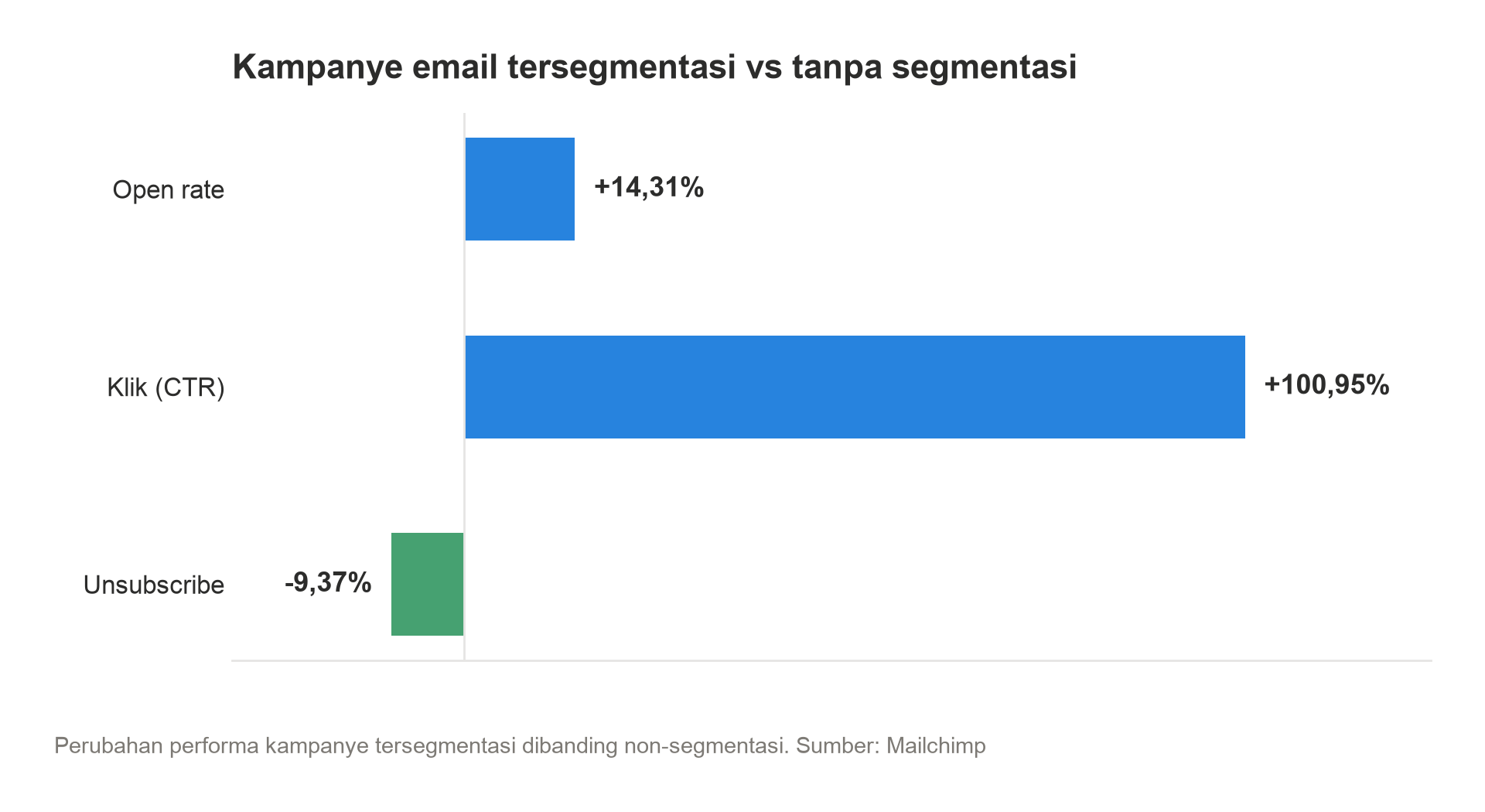
Segmented vs non-segmented email campaign performance. Source: Mailchimp. Chart labels in Indonesian, localize before publish.
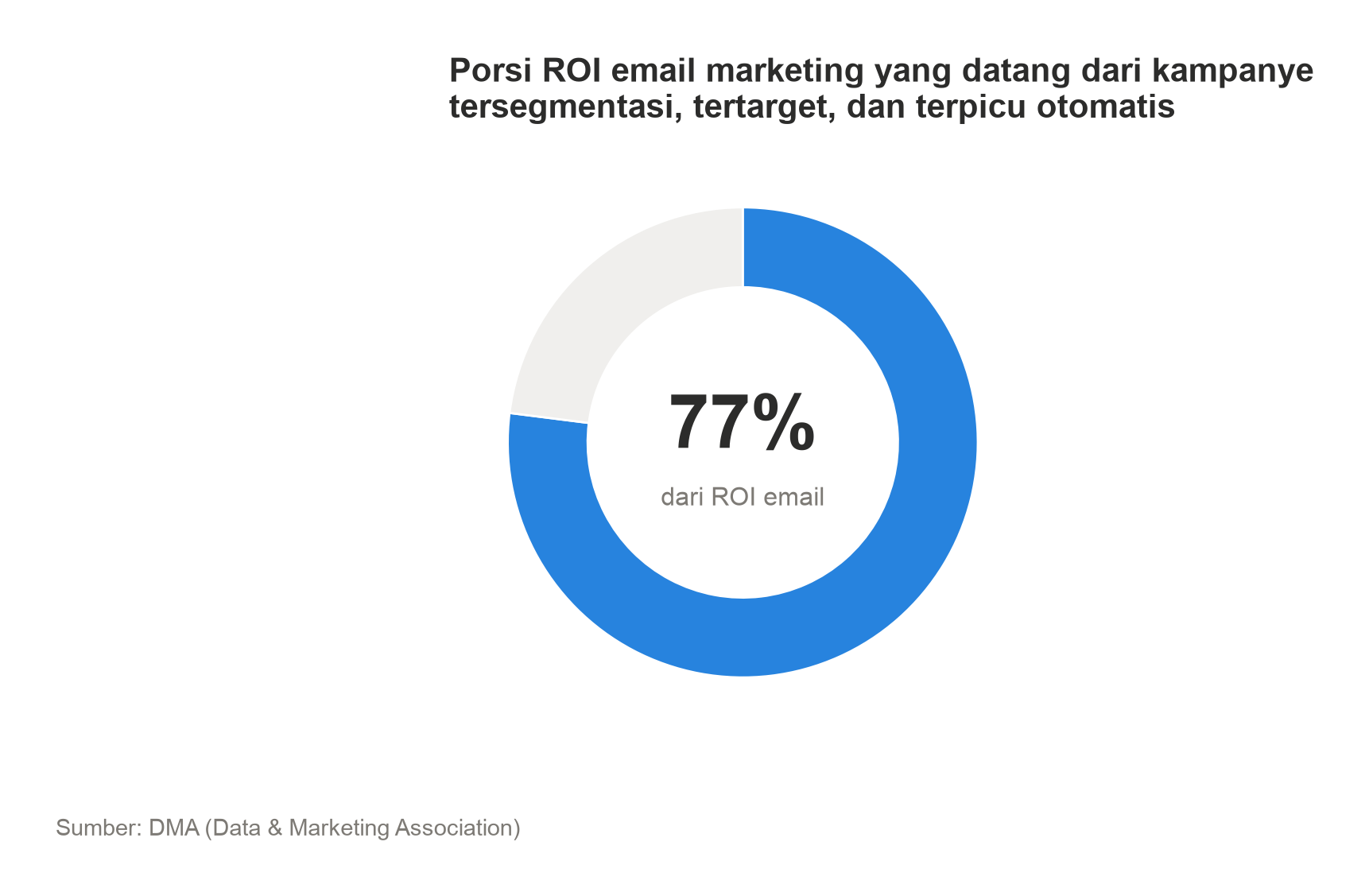
77% of email marketing ROI comes from segmented, targeted, and triggered campaigns. Source: DMA. Chart labels in Indonesian, localize before publish.
The doubled click rate is not about better emails. The content can be identical. Only the audience changes, the right message finally reaches people who care. Paid ads work the same way, identical budgets convert better when the audience is split correctly.
How Do You Segment a Market?
Start with the customer data you already have. Transactions, website analytics, and surveys are more honest than internal assumptions.
Pick the most relevant basis. Behavioral if you have the data, demographic and geographic if you are starting from zero.
Build a profile per segment. A name, a needs description, and a size estimate give the whole team a shared language.
Test each segment's response. Run small campaigns per segment and compare CTR, CPA, and conversion.
Review regularly. Segments drift as products and markets change, revisit at least quarterly.
What Does Segmentation Look Like in Practice?
Case | Finding | Source |
|---|---|---|
Bain survey of global executives | 81% call segmentation critical to profit, yet only about 25% feel their company does it effectively | Bain & Company |
Cross-industry email benchmarks | Segmented campaigns consistently win on opens, clicks, and subscriber retention | Mailchimp |
Soedja D2C client (illustrative data) | One ad audience split into three behavioral segments, CPA down 31% on the same budget | Soedja |
How Does Segmenting Relate to Digital Ads?
Every modern ad platform is a segmentation machine. Custom audiences, lookalikes, and retargeting are just automated behavioral segmentation. Wasted ad spend almost always shares one root cause, a generic message forced to work for every segment at once. We cover how to read and optimize this in the complete performance marketing guide.
Want to know if your ad audience structure is segmented properly? Run the free ads analysis tool at soedja.com/tools.
Frequently Asked Questions
What does segmenting mean?
Segmenting means dividing a broad market into smaller groups of consumers with similar needs, characteristics, or behaviors so a business can serve each group more relevantly.
What are the 4 types of market segmentation?
Demographic by who the consumer is, geographic by where they are, psychographic by lifestyle and values, and behavioral by how they interact with the product.
What is STP?
STP stands for Segmenting, Targeting, Positioning. Divide the market into segments, choose the priority segments, then define how the brand should be positioned in their minds.
What is the difference between segmenting and targeting?
Segmenting divides the market into groups, targeting chooses which groups to pursue. Segmenting always comes first.
What is an example of segmenting in business?
A skincare brand splits its market into teens with acne concerns, office workers who want a practical routine, and consumers over 40 focused on anti-aging. Each segment gets different products and ad messages.
Conclusion
Segmenting is the foundation of every effective marketing decision, and the data is unambiguous, 77% of email ROI comes from segmented campaigns and clicks can double just by splitting the audience correctly. The question is not whether segmentation works but whether it is done seriously.
Start with the free STP worksheet at soedja.com/tools, audit your ad audience structure with the free analysis tool on the same page, or let the Soedja Performance Ads team build your segmentation from research to execution. The first consultation is free.
Founders at Soedja