





Bidding is the process of making an offer to compete for something in limited supply. In digital advertising, bidding means the price you are willing to pay for your ad to appear in an available slot, with the winner decided by an automated auction that runs in milliseconds.
Quick summary
Bidding is a price offer to win ad slots through an auction system
The auction winner is not the highest bid, but the strongest combination of bid and ad quality
There are three families of strategies, manual, automated, and smart bidding
The best strategy depends on your campaign goal and how much conversion data you have
The most expensive bidding mistakes are usually unrealistic targets, not bid amounts
What Is Bidding?
The word bidding shows up in many contexts. There is bidding at art auctions, in project tenders, even in games. The core idea is always the same, several parties make offers for one contested thing, and the best offer wins.
In digital advertising, the contested thing is attention. Ad slots on Google search results, Instagram feeds, or YouTube videos are limited, while the advertisers who want them far outnumber the space. Platforms use auctions to decide whose ad shows, in which position, and at what price. This auction happens every time a single impression becomes available, so in one day your campaign enters millions of tiny auctions.
How the Ad Auction Works on Google and Meta
Every impression is contested through a separate auction that finishes before the page loads. Here is the flow.
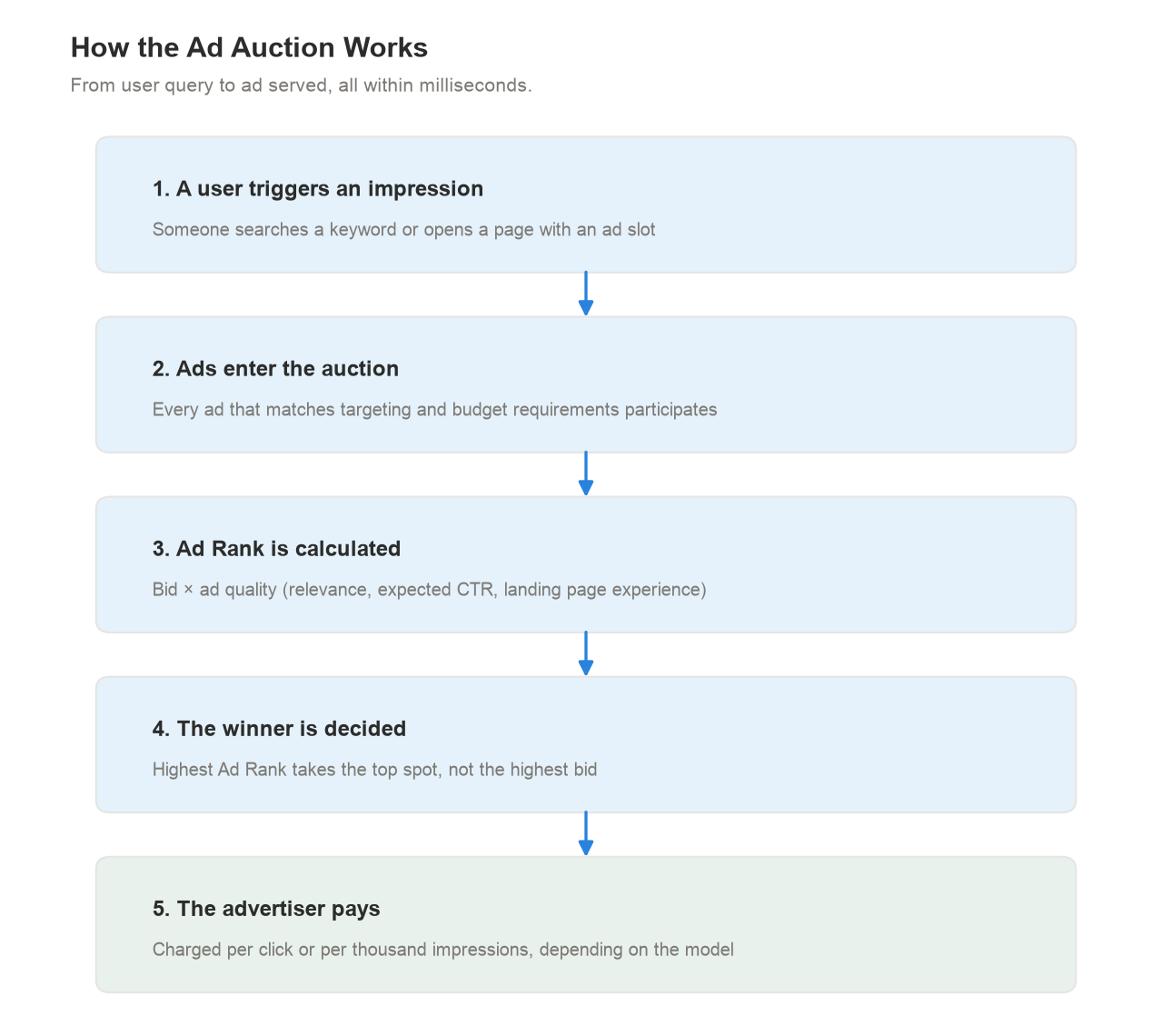
Ad auction flow from available impression to ad served, applies with small variations on both Google and Meta
The most misunderstood part sits in steps three and four. The winner is not the highest bid. Google calculates Ad Rank, a combination of your bid and quality components covering ad relevance, expected CTR, and landing page experience. Meta uses a similar formula called total value, combining bid, estimated action rates, and ad quality. A relevant ad can win the auction while paying less than a competitor who simply throws money at bids.
This is good news for advertisers with limited budgets. You do not need to be the biggest bidder to win, just the most relevant one for that search or audience.
Types of Bidding Strategies
Every option in an ads dashboard falls into one of three big families.
Family | How it works | Example strategies | Best for |
|---|---|---|---|
Manual bidding | You set the maximum bid per keyword or placement yourself | Manual CPC | Small budgets, test campaigns, full control |
Automated bidding | The platform manages bids toward one simple goal | Maximize clicks | Gathering traffic and early data |
Smart bidding | Machine learning sets a bid per auction using real time signals like device, location, and time of day | Maximize conversions, target CPA, target ROAS | Campaigns with proper conversion tracking and enough data volume |
The two most used smart bidding strategies follow different logic. Target CPA tells the system to chase a specific cost per conversion, which suits lead generation. Target ROAS tells the system to chase a revenue to ad cost ratio, which suits e-commerce where order values vary.
The difference in results only shows after smart bidding gets past its learning phase.
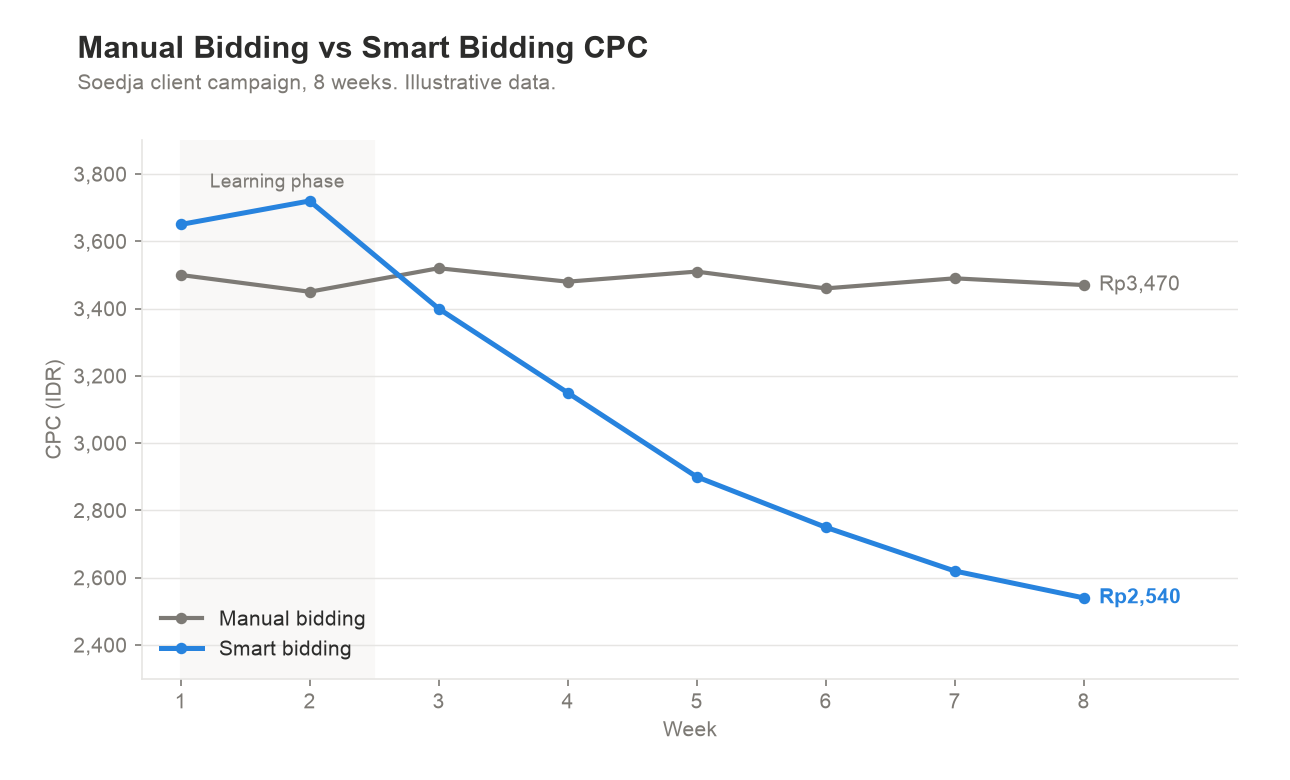
Manual bidding vs smart bidding CPC from a Soedja client campaign, illustrative data
The pattern almost always looks like this. In the early weeks smart bidding is actually more expensive because the system is still learning, then it drops and stabilizes once the algorithm finds conversion patterns. Many advertisers panic and switch it off in week two, right before the results arrive.
Bidding Outside of Advertising
To avoid confusion, bidding outside advertising works slightly differently. In a public auction, offers keep climbing until one highest bidder remains. In tenders or procurement, the direction flips, participants submit sealed prices and the lowest qualified offer usually wins. The underlying principle matches the ad auction, competitive offers for something scarce.
How to Choose a Bidding Strategy for Your Campaign Goal
The sequence we use on client campaigns looks roughly like this.
New campaign with no conversion data. Start with manual CPC or maximize clicks. The goal is not profit yet, it is collecting clean click and conversion data
Tracking is solid and conversions are consistent. Move to maximize conversions. The system needs roughly 15 to 30 conversions per month to learn properly
You know your reasonable cost per conversion. Lock it in with a realistic target CPA, usually slightly above your actual average CPA
E-commerce with varied order values. Use target ROAS so the system prioritizes high value buyers, not just transaction counts
Awareness campaigns. Use impression based bidding like CPM, because what you are buying is reach, not clicks
One important rule, do not switch strategies too often. Every drastic change of strategy or target resets the system to its learning phase and performance dips temporarily.
Bidding Mistakes That Burn Your Budget
Unrealistic target CPA or ROAS. Overly aggressive targets make it hard for the system to find matching auctions, your ads stop showing and data stops flowing
Smart bidding without proper conversion tracking. The system still optimizes, just toward the wrong signals. This is the most expensive mistake because it is invisible on the dashboard
Changing bids or targets every few days. The system never exits the learning phase and never reaches stable performance
High bids on broad keywords without negative keywords. You win lots of irrelevant auctions at premium prices
Judging results during the learning phase. Decisions get made on data that does not represent real performance yet
If your campaign is already running and you want to know whether the bidding setup is healthy, Soedja's free ads analysis tools can read the data and point out what needs fixing.
Frequently Asked Questions
What does bidding mean in advertising?
Bidding means the price an advertiser is willing to pay to show their ad in an available slot. That offer enters an automated auction, and the winner is decided by the combination of bid amount and ad quality.
What is the difference between manual and smart bidding?
With manual bidding you set the maximum bid yourself and it stays fixed until you change it. With smart bidding, machine learning calculates a different bid for every auction based on how likely it is to convert. Manual gives you control, smart bidding gives you scale.
Which bidding strategy should beginners use?
Start with maximize clicks or manual CPC on a small budget to gather data, while making sure conversion tracking is set up correctly. Once conversions are consistent, move up to maximize conversions, then lock in a target CPA.
Conclusion
Bidding is the core mechanism that decides whose ad shows and at what price. Because auction winners are decided by bid and quality together, the cheapest way to win auctions is not raising your budget, it is raising your relevance. Pick a strategy that matches how mature your campaign data is, give the learning phase time, and measure the outcome with cost metrics like CPC and end results like ROAS.
For the bigger framework, read our complete performance marketing guide. To check the current state of your campaign bidding, use our free ads analysis tools. And if you need a team that manages bidding all the way to business numbers, Soedja Performance Ads can help, the first consultation is free.
Founders at Soedja