





ROAS is short for return on ad spend, the ratio that compares revenue generated by ads with the money spent on those ads. The formula is simple, ad revenue divided by ad cost. A ROAS of 4 means every 1 dollar of ad budget returns 4 dollars in revenue.
Quick summary
ROAS measures ad payback, calculated as ad revenue divided by ad cost.
A good ROAS is not one universal number, the right target comes from your product margin.
Break even ROAS equals 100 divided by gross margin in percent.
ROAS differs from ROI because it only counts ad cost, not total business cost.
ROAS improves through levers you control, from bidding and CTR to conversion rate.
What Is ROAS?
ROAS answers the one question business owners ask their ad team most often, how much money did this ad budget bring back. Metrics like impressions, clicks, and CTR describe the process, ROAS describes the end result in the language of money.
The formula looks like this.
ROAS = revenue from ads ÷ ad cost
The result is usually written as a multiple, for example ROAS 4 or 4x. Some teams write it as a 4:1 ratio or 400%, the meaning is identical.
How Do You Calculate ROAS?
Take the revenue your ads generated in a period, then divide it by the ad cost in that same period.
E-commerce example. An online store spends USD 1,000 on ads in a month. The ads generate USD 4,500 in tracked sales. ROAS is 4,500 divided by 1,000, which equals 4.5. Every dollar of ads returns 4.5 dollars in sales.
Service business example. A consultancy spends USD 500 on lead generation ads. The ads produce 20 leads, 4 of them close with a total contract value of USD 3,000. ROAS is 6. For service businesses the key is tracking lead source all the way to closing, because without it ad revenue cannot be separated from organic revenue.
What usually makes ROAS misleading is not the formula but the attribution. Make sure the conversions your platforms count are real sales, not double counting where Google and Meta both claim the same purchase.
What Is a Good ROAS?
There is no single magic number. A ROAS of 4 can be highly profitable for a high margin product and a loss for a thin margin one. Setting the right target starts from break even ROAS, the minimum point where ads stop losing money.
Break even ROAS = 100 ÷ gross margin (%)
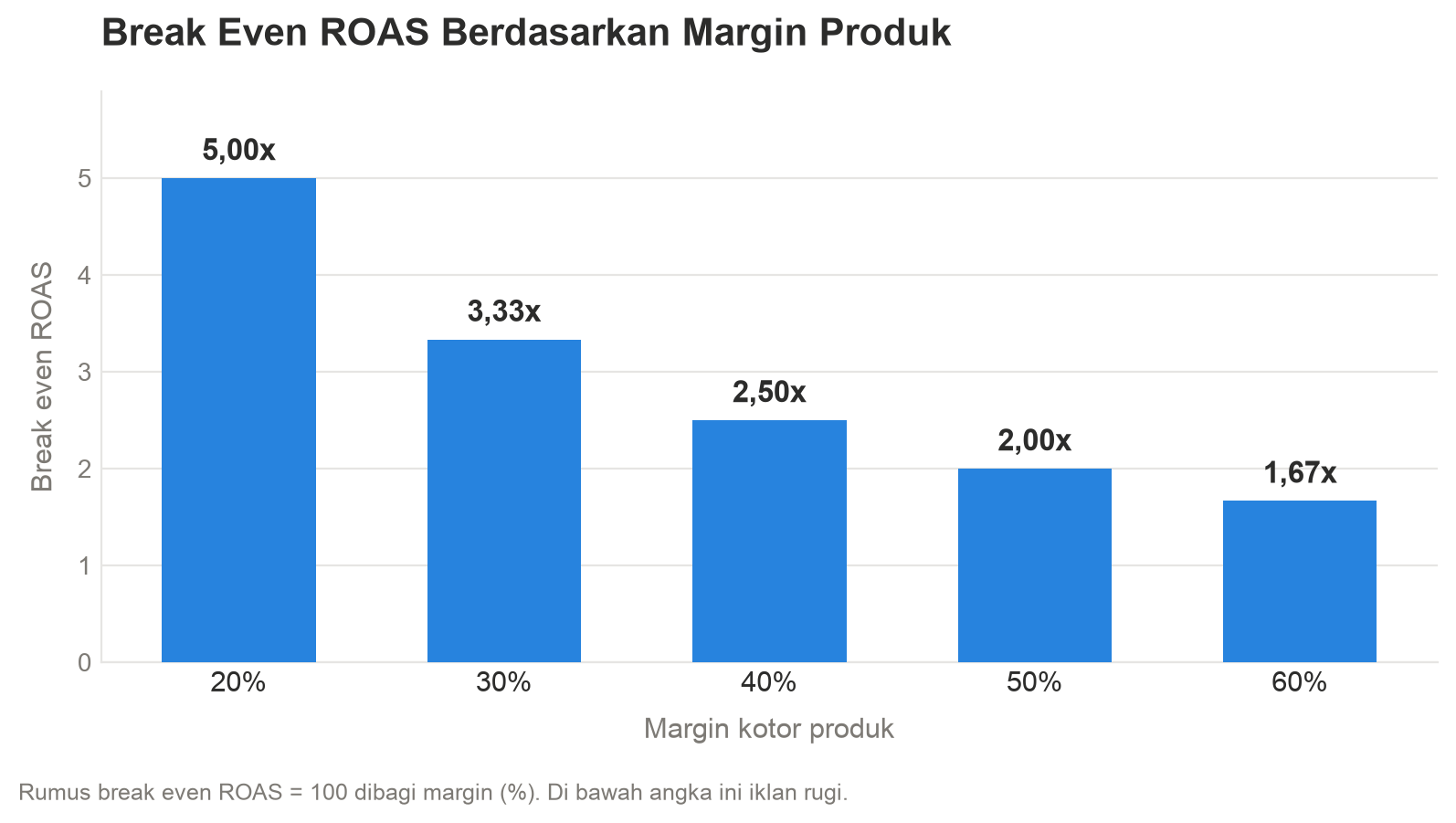
Break even ROAS simulation by product gross margin. Chart labels in Indonesian, localize before publish.
Read it like this. A product with 20% gross margin needs at least ROAS 5 just to break even. A product with 60% margin is already profitable at 1.67. This is why comparing ROAS between businesses without margin context means nothing.
Gross margin | Break even ROAS | Healthy target (± 1.5x break even) |
|---|---|---|
20% | 5.00 | 7.5 or higher |
30% | 3.33 | 5.0 or higher |
40% | 2.50 | 3.8 or higher |
50% | 2.00 | 3.0 or higher |
60% | 1.67 | 2.5 or higher |
The healthy target column uses a rough 1.5 times break even rule so there is room for operating cost and profit. Adjust it to your own cost structure.
How Does ROAS Work on Marketplace Ads?
The principle is the same on Shopee, Tokopedia, Amazon, or any marketplace ad platform, with a few marketplace specifics.
Marketplace ad dashboards calculate ROAS from attributed sales divided by ad cost, so the number is available without any tracking setup.
Break even ROAS on marketplaces must account for admin fees, free shipping programs, and platform commissions that eat into margin. Use the net margin after those cuts in the break even formula.
Calculate ROAS per SKU, not only per account. Thin margin and thick margin products need different targets even in the same store.
Product search ads usually deliver higher ROAS than recommendation placements because buyer intent is more mature. Compare both before adding budget.
What Is the Difference Between ROAS and ROI?
Aspect | ROAS | ROI |
|---|---|---|
Formula | Ad revenue ÷ ad cost | (Profit − total cost) ÷ total cost |
Costs included | Ad cost only | All costs, from product and operations to agency fees |
Decision level | Tactical, judging campaigns and channels | Strategic, judging the business or program as a whole |
Best used for | Daily optimization and budget allocation between campaigns | Monthly or quarterly review with management |
Use both together rather than picking one. ROAS decides which campaign gets paused this week, ROI decides whether the ad channel as a whole deserves to continue.
How Do You Increase ROAS?
ROAS is a downstream metric. The number moves when you move the levers upstream of it.
Fix your bidding strategy. Smart bidding with a target ROAS only works once conversion data is sufficient.
Raise your conversion rate. A slow landing page or a long form wastes clicks you already paid for.
Improve CTR with more relevant copy and creative. Healthy CTR lowers your cost per click through quality score.
Reduce CPC without sacrificing traffic quality. Cheap clicks from the wrong audience still produce low ROAS.
Audit placements and CPM. Expensive impressions in placements that never perform quietly drain the budget.
Increase average order value. Bundling and upsells raise revenue per conversion without adding any ad cost.
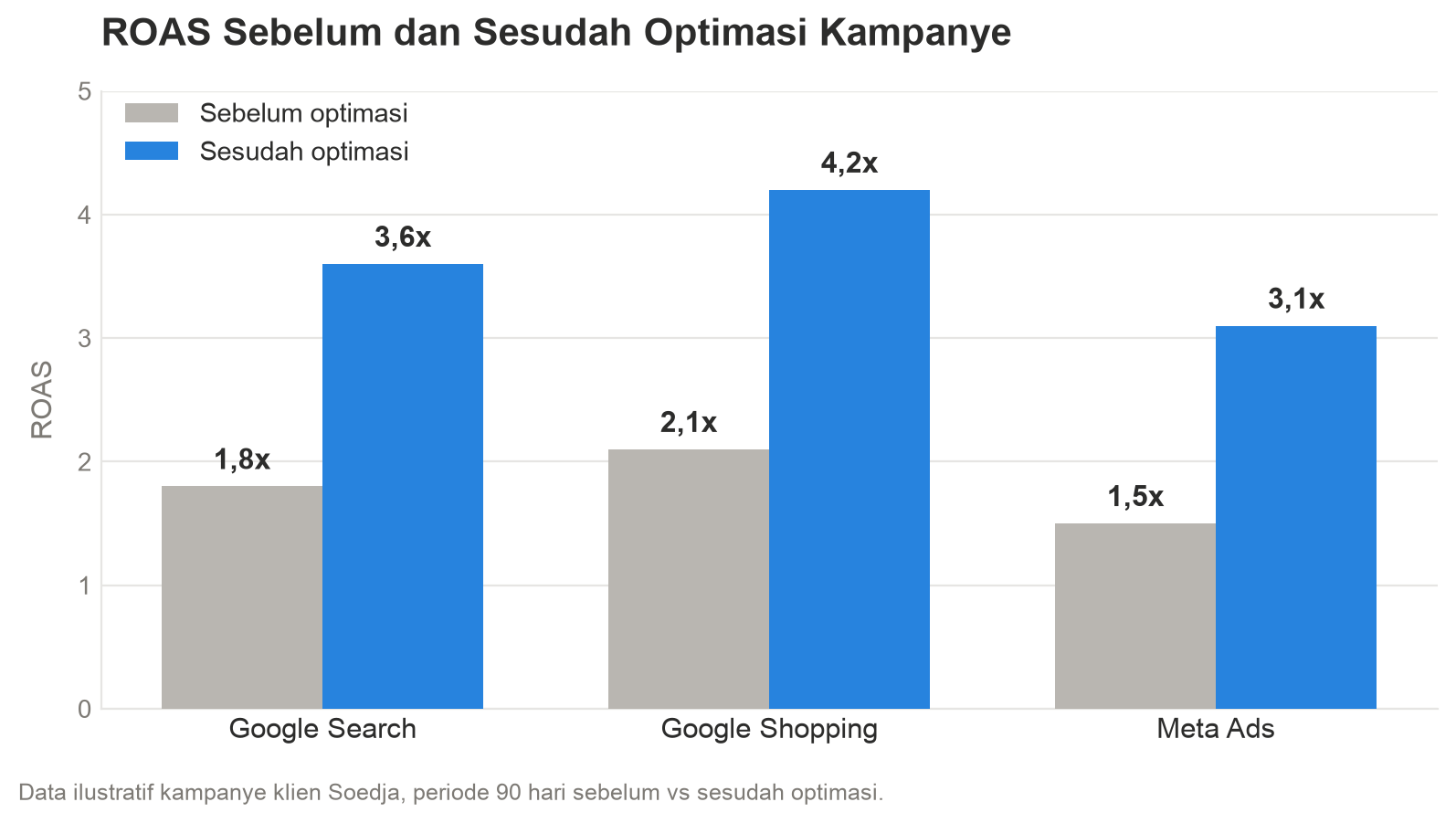
ROAS before and after campaign optimization, Soedja client data. Chart labels in Indonesian, localize before publish.
The chart shows a pattern we see consistently, the biggest ROAS gains rarely come from one big change. They come from several small levers fixed in sequence, from campaign structure and bidding to the landing page.
Free Calculator and Templates
All free at soedja.com/tools.
Break even ROAS calculator based on product margin
Monthly ad performance report template
Free ads analysis tool to check the health of your campaign numbers
Frequently Asked Questions
What is a good ROAS?
It depends on your product margin. The minimum benchmark is break even ROAS, which is 100 divided by gross margin in percent. A product with 25% margin needs at least ROAS 4 to break even, so a healthy target sits above that.
What is the difference between ROAS and ROI?
ROAS only compares ad revenue with ad cost, ROI measures profit against all business costs. ROAS is for tactical decisions between campaigns, ROI is for overall judgment.
How do you calculate ROAS?
Divide the revenue generated by ads by the ad cost in the same period. USD 10,000 in ads that produces USD 45,000 in sales means a ROAS of 4.5.
Conclusion
ROAS translates all the work behind your ads into one payback number, and that number only means something once you compare it with the break even point from your own product margin. Calculate break even first, then set the target, then move the levers one by one.
Start with the free break even ROAS calculator at soedja.com/tools, and if you want your campaigns run against a clear ROAS target with monthly accountability, there is Soedja Performance Ads. We cover the full approach in the complete performance marketing guide.
Editorial Team