





A conversion is the valuable action someone takes after interacting with your ad or website, such as buying a product, filling in a form, or signing up. In digital advertising, conversions are the success measure closest to money, because every other metric only matters if it eventually produces conversions.
Quick summary
A conversion is a business valuable action taken by your audience after seeing an ad
Conversions split into two kinds, macro for primary actions and micro for small steps toward them
Conversion rate is calculated from conversions divided by clicks or visits
Average search ads conversion rate sits around 7 percent, but normal ranges differ wildly by industry
The fastest conversion rate gains usually live on the landing page, not in the ad
What Is a Conversion in Marketing?
Outside marketing, conversion means changing from one form to another. There is currency conversion, unit conversion, file conversion. The core meaning is the same, something transforms into a different state.
In marketing, what transforms is the person's status. A conversion happens when someone goes from merely viewing or visiting to taking an action that has business value. You define that action yourself based on your business model, it can be a purchase, a form submission, an account signup, or a WhatsApp chat. Because the definition is up to you, the correct first step is deciding which action counts as a conversion before the campaign runs.
Types of Conversions
The most useful split in practice is macro versus micro.
Type | Definition | Examples |
|---|---|---|
Macro conversion | The primary action that is the business end goal | Purchase, lead form submitted, subscription started |
Micro conversion | A small step showing someone is moving toward the primary action | Add to cart, form started, pricing page viewed, WhatsApp button clicked |
Examples by business model. E-commerce counts purchases as macro and add to cart as micro. Service businesses count consultation forms as macro and WhatsApp clicks as micro. SaaS counts paid subscriptions as macro and trial signups as micro. Micro conversions matter because they happen in larger numbers, giving ad systems more data to learn from, especially in campaigns where macro conversions are still rare.
Conversion Rate, the Formula, and How to Calculate It
Conversion rate, or CVR, is the percentage of people who convert out of everyone who interacted.
Conversion\ rate = \frac{conversions}{clicks\ or\ visits} \times 100\%
For example, your ads got 7,500 clicks this month and produced 340 leads. The conversion rate is 340 divided by 7,500, which equals 4.5 percent. The number is easiest to understand as a funnel.
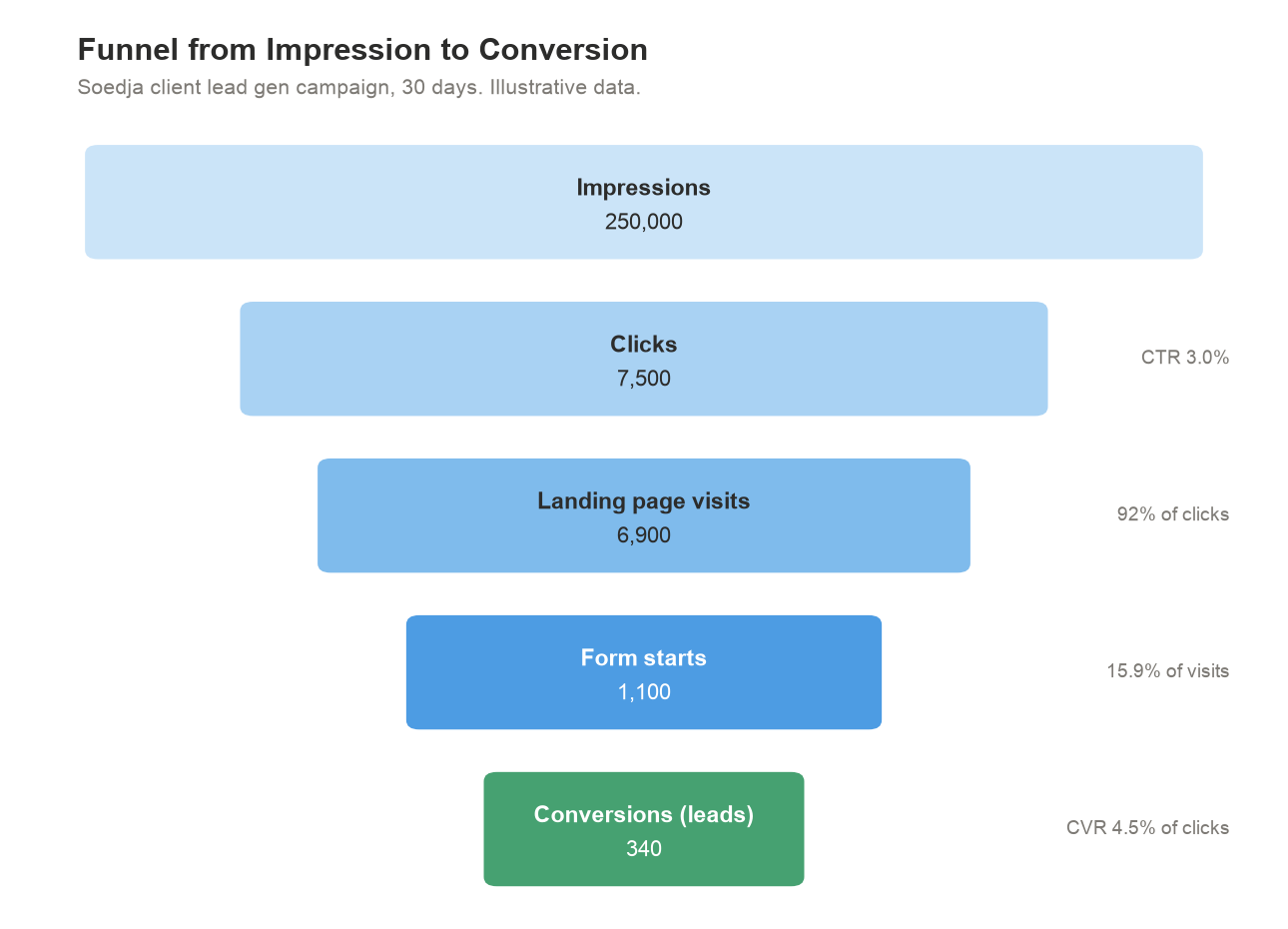
Funnel from impressions to conversions on a Soedja client lead gen campaign, illustrative data
Every funnel stage leaks, that is normal. The job of optimization is finding the biggest leak. In this example, the sharpest drop happens between landing page visits and form starts, so the highest impact fix is on the landing page, not the ad.
Cost per Conversion and How It Relates to CPA
Cost per conversion is total ad spend divided by the number of conversions. If you spent IDR 17,000,000 and got 340 leads, your cost per conversion is IDR 50,000 per lead. The term CPA, cost per acquisition, refers to the same idea, platforms just name it differently.
Cost per conversion is the twin of conversion rate. When CVR goes up, cost per conversion almost always goes down, because you get more results from the same number of clicks. These two numbers decide whether the target CPA in your bidding strategy is realistic.
Conversion Rate Benchmarks by Industry
The average Google Ads conversion rate across industries sits at 7.52 percent according to WordStream 2025 data. But blended averages mislead when used alone, because the range between industries is enormous.
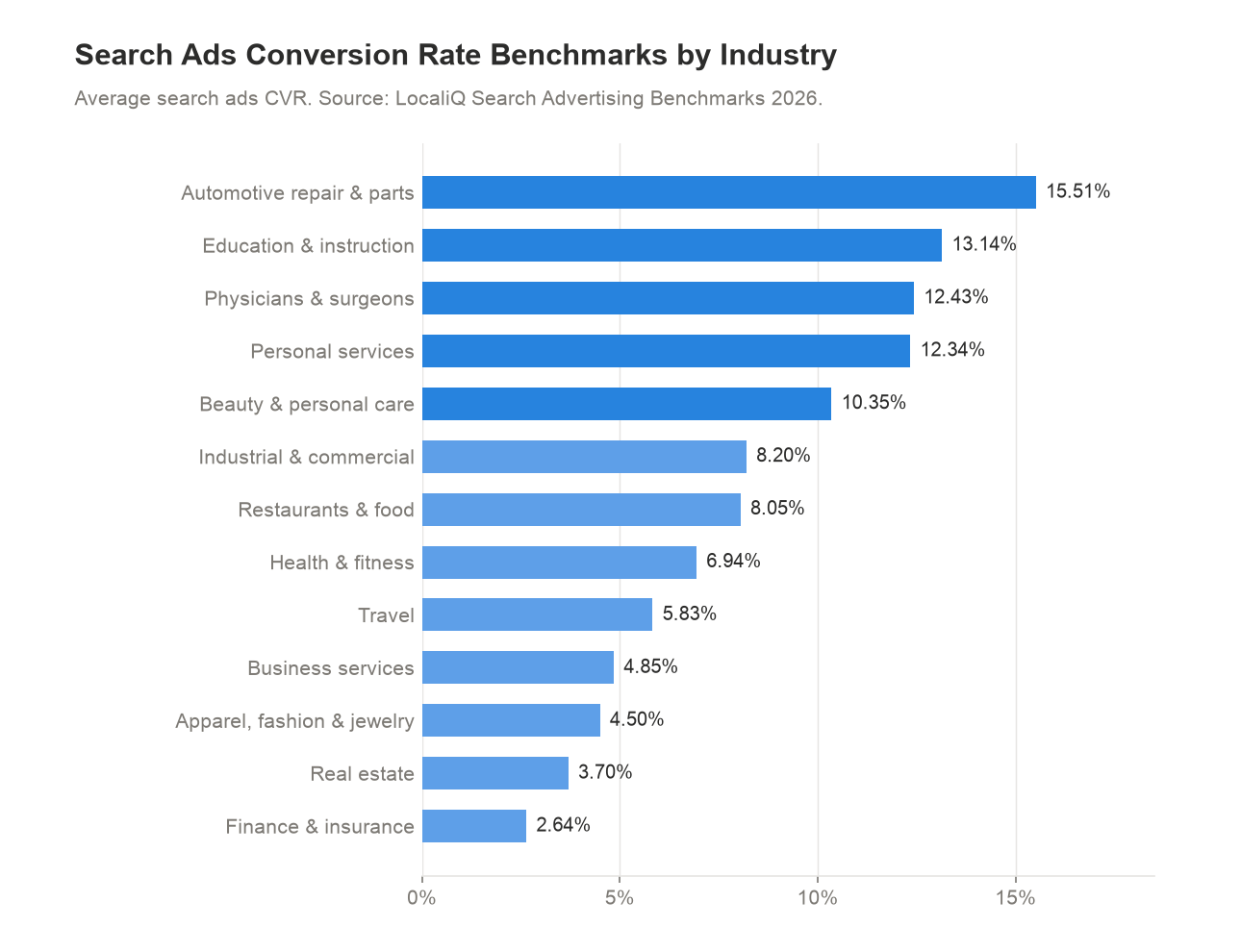
Search ads conversion rate benchmarks by industry. Source. LocaliQ Search Advertising Benchmarks 2026
The gap between the top and bottom industries is nearly six times according to LocaliQ 2026 data. Automotive repair converts above 15 percent because the search intent is urgent, while finance and insurance sits under 3 percent because the decision cycle is long. Compare your performance against your own industry, not the blended average.
5 Ways to Raise Conversion Rate Based on Campaign Data
Match the ad message to the landing page. People who click an ad with a specific promise must find the same promise on the destination page. Message mismatch is the most common cause of low CVR
Fix the landing page before blaming the ad. Speed up loading, simplify forms, and move the CTA above the fold. In the example funnel above, the biggest leak sits at this stage
Split campaigns by audience segment. Each segment has different motivations, and one message for everyone is usually sharp for no one
Cut irrelevant traffic. Read search term reports regularly and add negative keywords, because the wrong click will never become a conversion
Test one element at a time and document it. Change the headline, form, or CTA one by one so it is clear what works. How to turn test data into decisions is covered in our article on insights
Frequently Asked Questions
What does conversion mean in advertising?
A conversion in advertising is a business valuable action someone takes after seeing or clicking an ad, such as purchasing, submitting a form, or signing up. The advertiser decides which action counts as a conversion.
What is a good conversion rate?
Search ads average around 7 percent, but normal ranges differ hugely by industry, from under 3 percent to above 15 percent. The most useful benchmark is your own industry, then beating your own number from last month.
What is the difference between a conversion and conversion rate?
A conversion is the action, conversion rate is the percentage. Conversions are counted as events, for example 340 leads. Conversion rate divides that count by total clicks or visits to measure how efficiently traffic turns into results.
Conclusion
A conversion is the point where ad spend turns into business results, and conversion rate measures how efficiently that happens. Define which action counts as a conversion first, set up tracking correctly, then read the funnel to find the biggest leak. Almost always, the cheapest improvements are in the landing page and segmentation, not in adding budget.
For the bigger framework, read our complete performance marketing guide. To check whether your campaign's conversion rate is healthy, use Soedja's free ads analysis tools. And if you need a team that grows conversions all the way to business numbers, Soedja Performance Ads can help, the first consultation is free.
Editorial Team